
Data Center Cooling System
Data centers generate significant amounts of heat due to the continuous operation of servers, networking equipment, and power systems. Maintaining stable temperatures is essential to ensure reliable performance, prevent hardware failures, and support uninterrupted digital services.
Unlike intermittent industrial processes, data center equipment operates continuously, often at high computational loads. Even small temperature fluctuations can affect system stability, reduce equipment lifespan, and increase the risk of unexpected downtime.
A properly designed data center cooling system provides consistent heat removal, maintains optimal operating conditions, and supports long-term operational reliability.
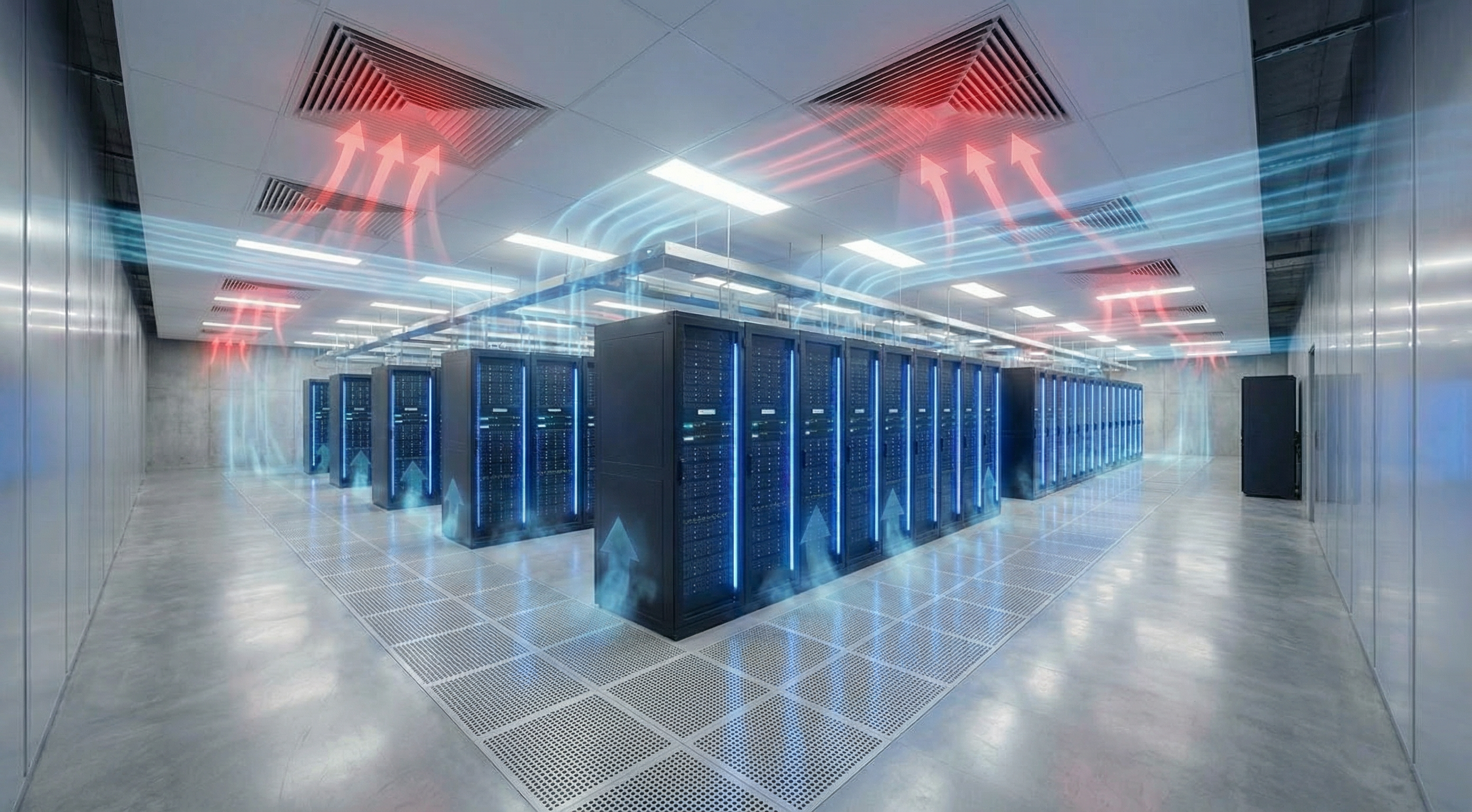
Core Requirements and Challenges
Data center cooling systems must operate under demanding conditions where continuous performance, energy efficiency, and operational reliability are essential.
To maintain stable operating environments for critical IT infrastructure, cooling systems must meet strict technical requirements while addressing operational challenges associated with high-density computing environments.
Core System Requirements

Operational Challenges
- High heat density:Modern servers and high-performance computing equipment generate concentrated heat within limited physical space.
This increases the demand for efficient heat transfer and consistent cooling capacity. - Load variability:Computing workloads can fluctuate depending on processing demand, leading to variations in heat generation.
Cooling systems must respond quickly to changing thermal loads while maintaining stable operating conditions. - Continuous system availability:Unexpected cooling system failure can result in rapid temperature increases and potential equipment shutdown.
Maintaining continuous system availability requires robust system design and reliable operation. - Energy management pressure:As data centers grow in size and computing capacity, energy consumption becomes a major operational concern.
Cooling systems must balance performance requirements with energy efficiency targets.
Common System Solutions
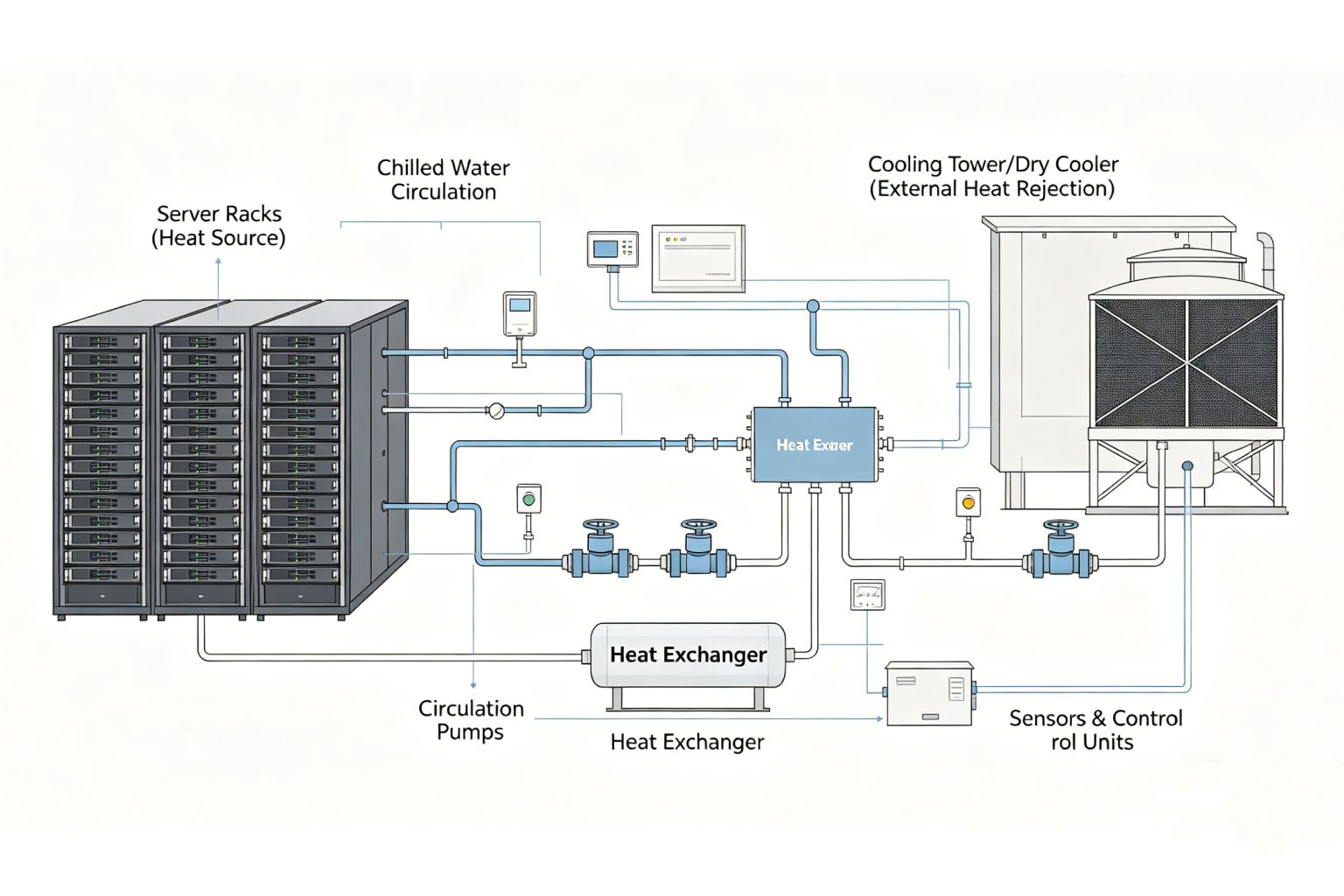
A typical data center cooling system is designed to transfer heat generated by IT equipment to an external heat rejection source through a controlled cooling loop.
The system generally consists of the following functional components:
Heat source-Servers, storage devices, and networking equipment generate heat during operation.
Cooling distribution system-Chilled water or coolant circulates through the facility to absorb heat from equipment.
Heat exchange-Heat exchangers transfer thermal energy from the internal cooling loop to an external cooling medium such as cooling towers, dry coolers, or chilled water systems.
Circulation system-Pumps maintain continuous coolant flow and ensure stable heat transfer throughout the system.
Control and monitoring system-Sensors and control units regulate temperature, flow rate, and system operation to maintain stable performance.
This system architecture enables continuous thermal management while maintaining operational reliability.
System Working Logic
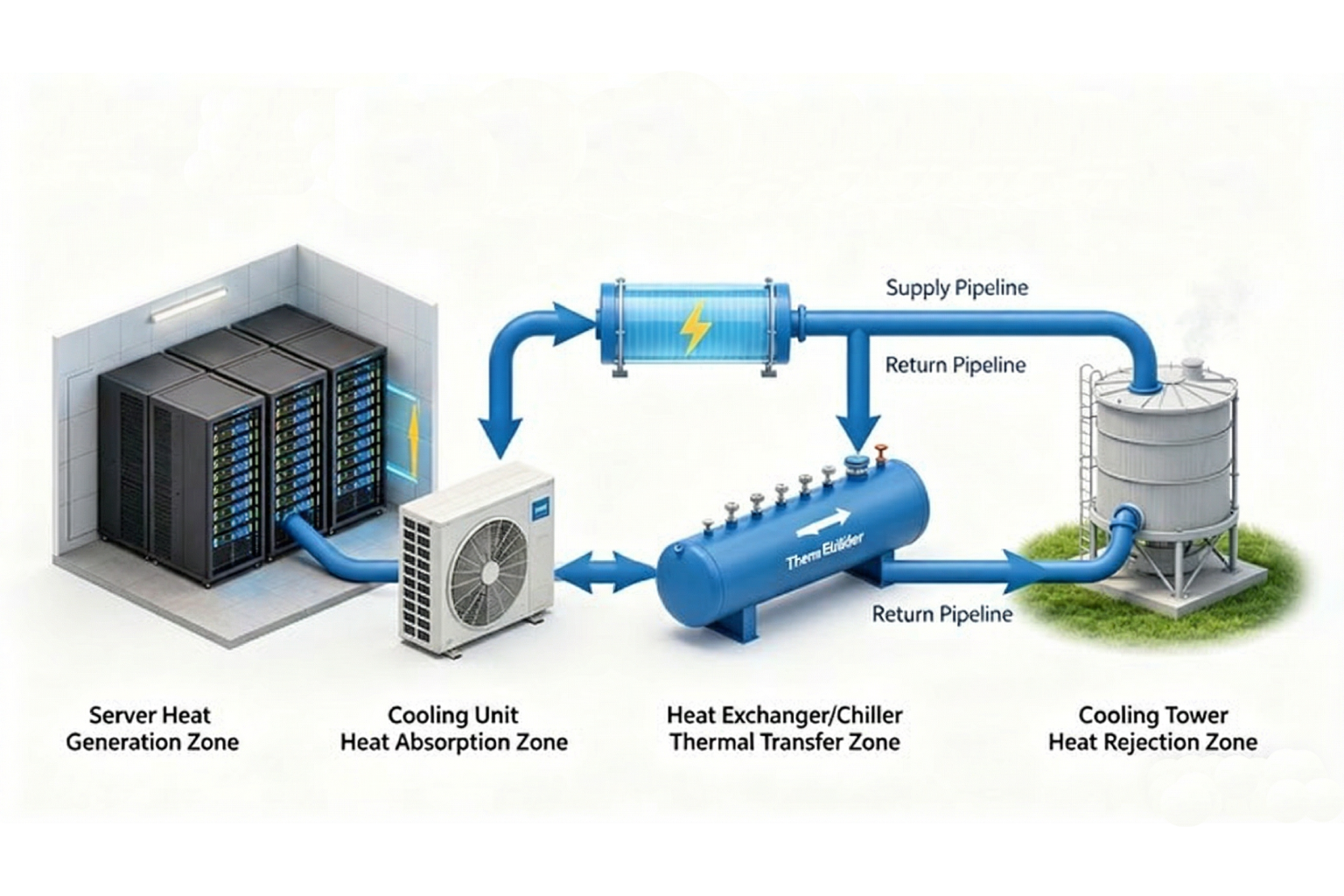
The working logic of a data center cooling system is based on continuous heat transfer and controlled fluid circulation to maintain stable operating temperatures.
The system operates through a continuous cooling cycle consisting of the following processes:
Heat generation:Servers and electronic equipment continuously generate heat during operation.
Heat absorption:Cooling fluid circulates through cooling units or heat exchangers to absorb heat from equipment.
Heat transfer:The heated fluid flows to a heat exchanger where thermal energy is transferred to an external cooling medium.
Heat rejection:The external cooling system releases heat to the surrounding environment.
Fluid recirculation:The cooled fluid returns to the system to repeat the cooling cycle.
This continuous circulation process ensures stable temperature control and reliable system operation.
Suitable Product Types and System Configuration
Several types of thermal management equipment are commonly used to support data center cooling systems. The specific configuration depends on system size, cooling capacity, and operational requirements. Common equipment used in this system includes:
Plate Heat Exchangers are used for efficient heat transfer between internal cooling loops and external cooling systems.
Shell and Tube Heat Exchangers are suitable for high-capacity cooling systems requiring durable and stable performance.
Dry Coolers are used to dissipate heat to the ambient environment without direct water consumption.
Circulation Pumps maintain stable coolant flow and support continuous system operation.
Expansion Tanks stabilize system pressure and accommodate thermal expansion of the cooling fluid.
These components work together to ensure reliable heat removal and stable temperature control.
Representative Application Environments
While system design principles remain consistent, specific operational conditions vary depending on facility size, infrastructure type, and cooling capacity requirements.
Common application environments include:
Enterprise data centers:(link to Industries → Data Centers)
Cloud computing facilities:(link to Industries → Cloud Infrastructure)
Telecommunication facilities:(link to Industries → Telecommunications)
Edge data centers:(link to Industries → Edge Computing)
High-performance computing facilities:(link to Industries → HPC Systems)