
Marine & Offshore
Marine Heat Exchangers & Oil Coolers for Marine and Offshore Thermal Management Systems
Marine and offshore systems operate in demanding environments where reliable thermal management is essential for safe and continuous operation. Equipment such as propulsion engines, hydraulic power units, generators, and onboard processing systems generate significant thermal loads that must be dissipated efficiently to maintain stable performance.
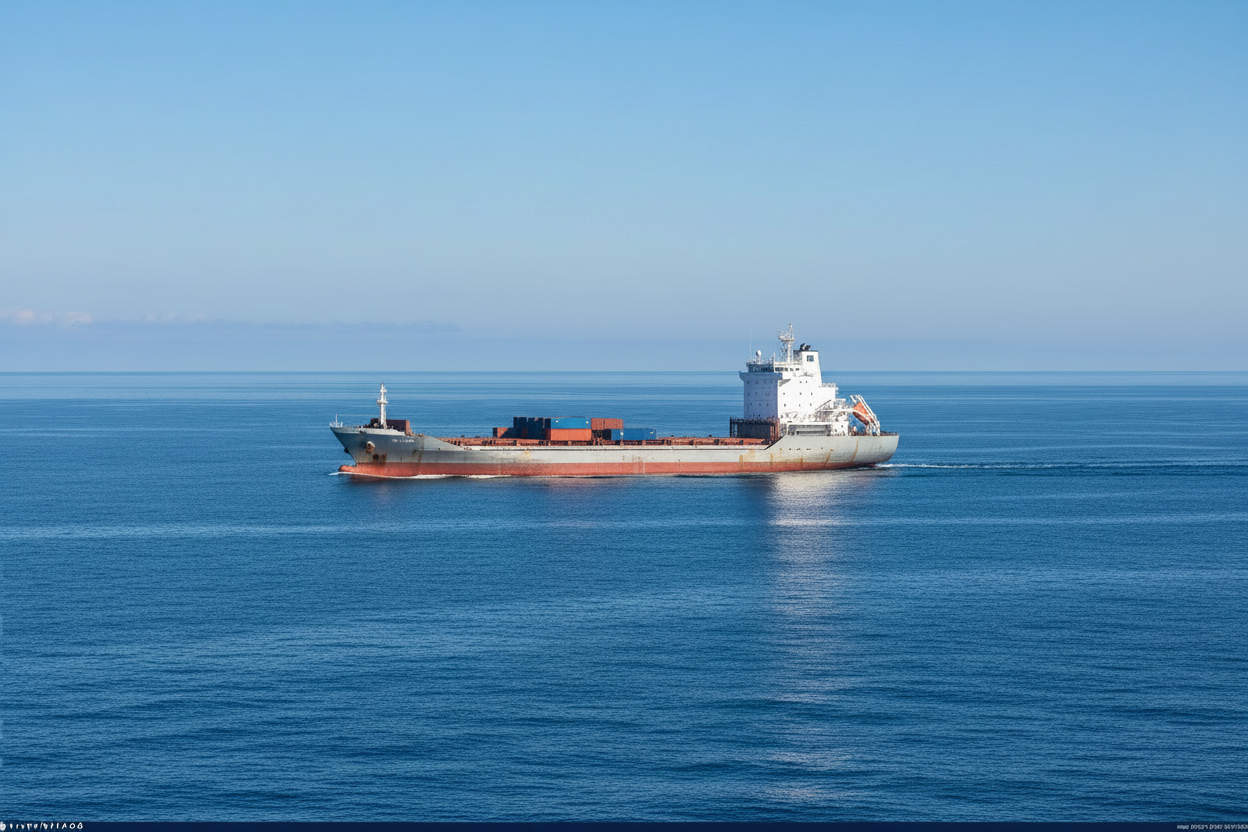
Marine heat exchangers and Marine Oil Coolers play a central role in these systems by transferring heat from primary equipment circuits to seawater or freshwater cooling loops. Proper thermal management supports equipment longevity, operational stability, and predictable system behavior under continuous-duty marine conditions.
Marine and offshore applications typically involve:
- Continuous operation under variable load conditions
- Limited onboard energy availability
- Exposure to vibration, motion, and corrosive environments
- Restricted maintenance access during operation
For these reasons, thermal management systems in marine environments are designed with a strong focus on reliability, heat transfer stability, and system integration.
In many offshore and vessel cooling systems, Shell and Tube Heat Exchangers are commonly used to support stable thermal performance in demanding operating conditions. Learn more about their design principles and industrial applications in our Shell and Tube Heat Exchanger guide.
System Requirements and Thermal Challenges
Marine and offshore cooling systems must maintain stable thermal performance under dynamic and often harsh operating conditions. System design is driven by both operational requirements and environmental constraints.
Core System Requirements

Typical Thermal Management Challenges
Marine systems frequently encounter the following operational challenges:
- Heat accumulation in confined engine rooms or enclosed equipment spaces
- Rapid thermal load fluctuations during maneuvering or load changes
- Continuous operation with limited maintenance opportunities
- Corrosion risks associated with seawater cooling environments
- Space constraints requiring compact system layouts
The primary engineering objective is to maintain stable thermal balance while ensuring long-term system reliability.
Role of Marine Heat Exchangers and Oil Coolers in System Design
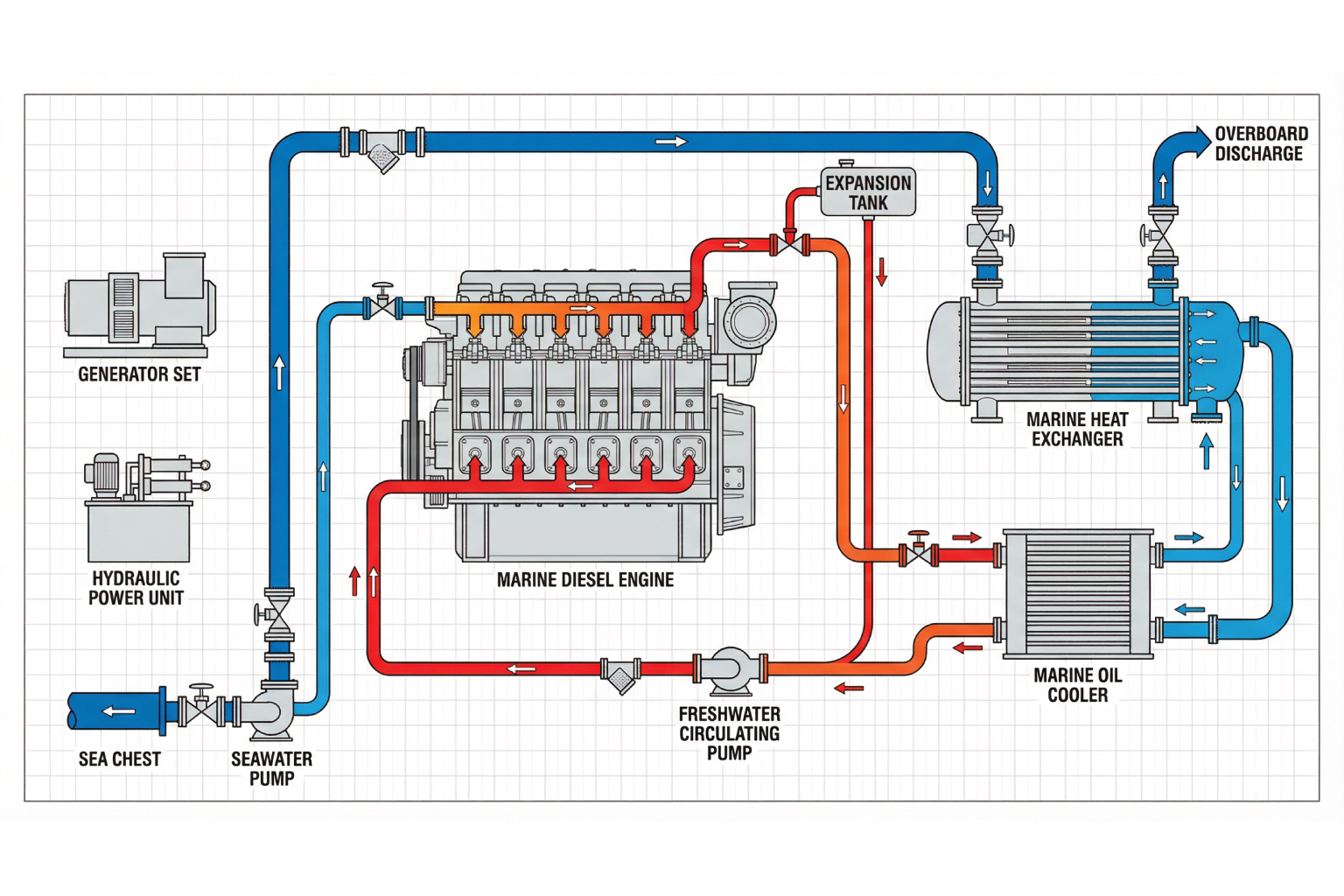
Marine heat exchangers and marine oil coolers are critical components in marine and offshore thermal management systems, where continuous operation and varying loads require stable and efficient heat transfer. Equipment such as engines, generators, and hydraulic units generate significant heat during operation, making reliable temperature control essential for maintaining system performance and equipment durability.
In typical marine cooling systems, heat exchangers transfer thermal energy from equipment cooling circuits to seawater or freshwater loops, while oil coolers regulate the temperature of lubricating or hydraulic oil to ensure consistent operating conditions. The proper integration of these components supports stable thermal balance, reduces mechanical stress, and enables reliable long-term operation in demanding marine environments.
System Operation Principles
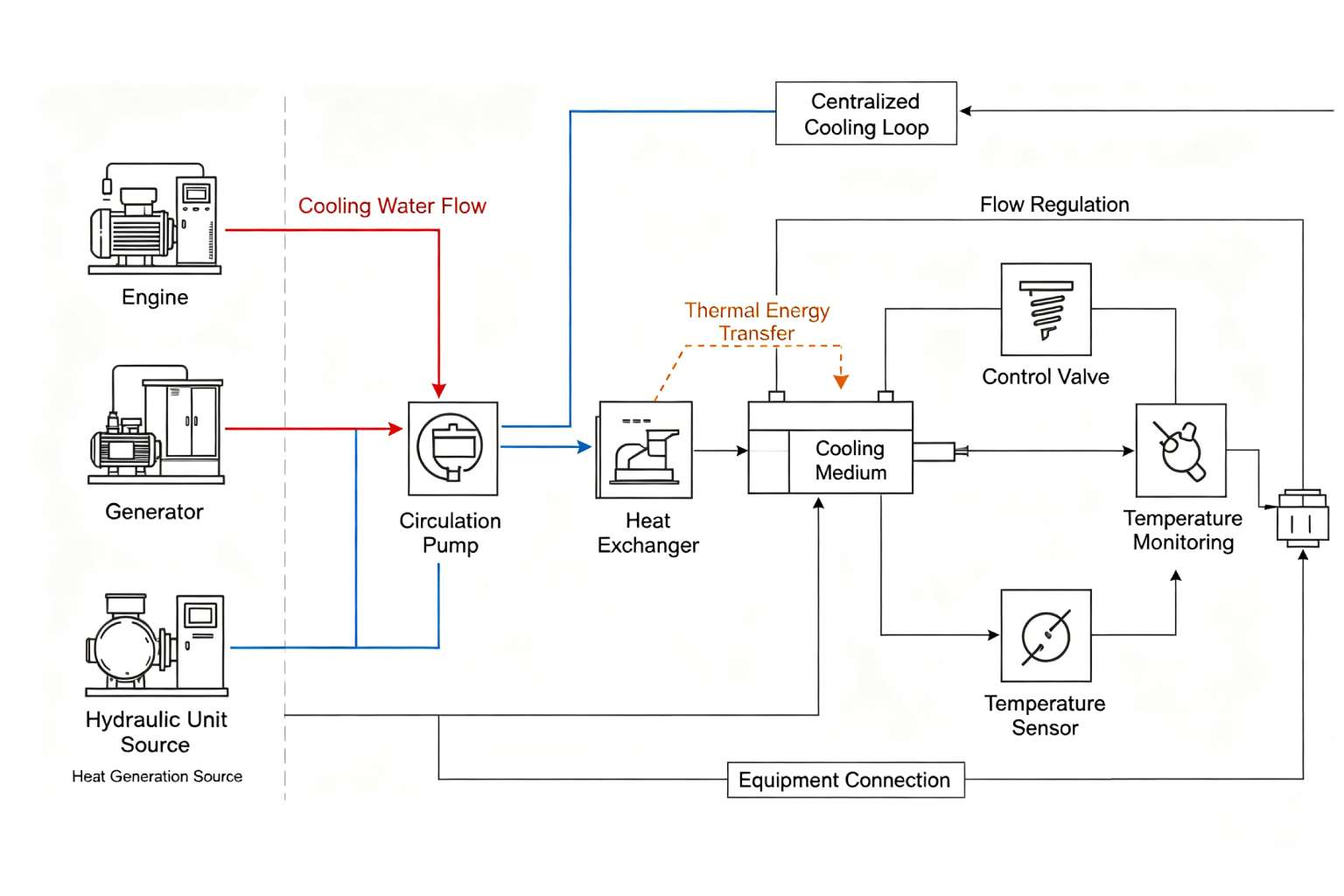
From a system perspective, thermal energy generated by onboard equipment is transferred through closed-loop cooling circuits to a secondary cooling medium via heat exchangers. The system is designed to maintain thermal balance while adapting to varying operational loads.
The system operation works as follows:
1. Heat is generated by onboard equipment during operation
2. The heat exchanger transfers thermal energy from the primary loop to the cooling medium
3. Circulation pumps maintain continuous fluid flow through the system
4. Control valves and sensors regulate flow and temperature to stabilize system performance
5. In centralized systems, thermal loads from multiple units are managed through a common cooling loop to optimize overall efficiency
Marine and Offshore Cooling System Solutions
Marine and offshore cooling systems are commonly implemented using standardized configurations designed to manage equipment heat loads under continuous-duty operating conditions. System layouts are typically selected based on equipment type, thermal load distribution, and operational reliability requirements.
Representative Marine and Offshore Application Environments
While system design principles remain consistent, specific operational considerations vary by application environment.
Common application environments include:
Commercial vessels (link to Industries → Heating and Hot Water Solutions for Vessels)
Offshore platforms (link to Industries → Cooling Solutions for Oil Cooling and Power Unit Systems
Marine hydraulic systems (link to Industries → Heating & Cooling Solutions for Hydraulic Equipment)
Onboard process and auxiliary systems (link to Industries → Manufacturing & Processing Heating Applications)
This page forms a loop with the corresponding Industries pages, enabling users to explore industry-specific operating conditions while maintaining a system-level understanding of marine and offshore applications.
FAQ
Marine and offshore HVAC systems are specialized climate control solutions engineered for ships, drilling rigs, production platforms, and other ocean-based facilities. Unlike standard land-based equipment, they must operate reliably in harsh marine environments marked by constant salt air, high humidity, continuous vibration, vessel motion, and extreme temperatures. These systems regulate indoor climate, maintain air quality, control space pressurization, and protect equipment and personnel across living quarters, engine rooms, control centers, and hazardous zones. Constructed from heavy-duty, corrosion-resistant materials, they comply with strict maritime classification society standards. Efficient marine and offshore HVAC systems minimize fuel consumption, support operational continuity, and ensure safety, comfort, and regulatory compliance across offshore and maritime operations.
Marine and offshore HVAC systems regulate temperature, humidity, air quality, and static pressure across ships, rigs, and floating platforms subject to salt spray, wind, structural vibration, and shifting weather. They draw in outdoor air, filter out airborne contaminants and salt particles, and cool or heat the air using coils connected to chillers, boilers, or heat pumps before distributing conditioned air through ductwork to cabins, control rooms, engine spaces, galleys, and technical spaces. High-capacity ventilation fans maintain fresh air exchange, while active dehumidification prevents structural corrosion, mold growth, and electrical failure. Differential room pressurization keeps smoke, toxic fumes, and explosive gases out of critical spaces. Built with marine-grade materials, these systems use automated controls to adjust airflow dynamically based on occupancy and load requirements.
Marine and offshore HVAC systems are deployed anywhere personnel, sensitive electronics, and critical processes require precise environmental control in marine settings. On commercial vessels, they serve cargo ships, tankers, cruise liners, ferries, and naval craft—conditioning cabins, navigation bridges, engine control rooms, galleys, and medical bays. Offshore, installations include oil and gas platforms, exploratory drilling rigs, FPSOs, offshore wind farm substations, service operation vessels (SOVs), and standalone accommodation modules. These systems also protect switchgear rooms, control centers, battery banks, and communication hubs from overheating, moisture, and salt-laden air. Beyond maintaining crew comfort, they ensure equipment reliability and safety compliance under extreme operational and weather conditions.
Marine and offshore HVAC systems deliver reliable environmental control in demanding marine settings, keeping vessels and offshore platforms operating safely and efficiently. By regulating temperature, humidity, and indoor air quality, they protect crew health, boost productivity, and alleviate fatigue during extended deployments at sea. They also safeguard sensitive electronics, general cargo, and control machinery from overheating, corrosion, and condensation damage. Engineered for severe duty, these systems withstand heavy vibration, fit within restricted spatial footprints, and endure harsh weather while meeting stringent safety and classification standards. Energy-efficient designs reduce fuel burn and operational expenditure, while reliable ventilation systems support fire safety, gas isolation, and environmental compliance across living quarters and technical compartments.
Selecting HVAC solutions for marine and offshore applications requires matching equipment performance to the specific vessel or platform type, operating climate, crew capacity, and process heat loads. Prioritize marine-grade, corrosion-resistant alloys, compact equipment footprints, structural vibration damping, and proven reliability in high-humidity, salt-laden atmospheres. System components must comply with relevant maritime classification rules and offshore safety regulations, balancing energy efficiency with easy serviceability in tight mechanical spaces. Airflow distribution designs must manage outdoor air intake, space pressurization, thermal stability, and moisture removal to protect both occupants and mission-critical systems. Finally, evaluate system redundancy, automated control options, high-efficiency filtration, and global spare parts availability to minimize operational downtime.
Applicable Product Types and System Configurations
Different system configurations are selected based on vessel type, operating conditions, and energy management strategies.


