
Swimming Pool Heating System Solutions
Swimming pool heating systems provide reliable temperature control by integrating heat exchangers, circulation pumps, expansion tanks, and other hydronic components into a complete thermal solution.
Whether powered by a boiler, heat pump, solar heating system, or other heat source, a properly designed system transfers heat efficiently while maintaining continuous water circulation, stable temperatures, and long-term operating reliability.
Designed for residential, commercial, hospitality, and public swimming pools, these systems improve energy efficiency, simplify maintenance, and deliver consistent heating performance under varying operating conditions.

System Requirements and Operational Challenges
Core Requirements of Swimming Pool Heating Systems

User & Experience Requirements
Common challenges include:
- Heat loss caused by evaporation and surface exposure
- Temperature fluctuations during peak usage periods
- Rising energy consumption during continuous operation
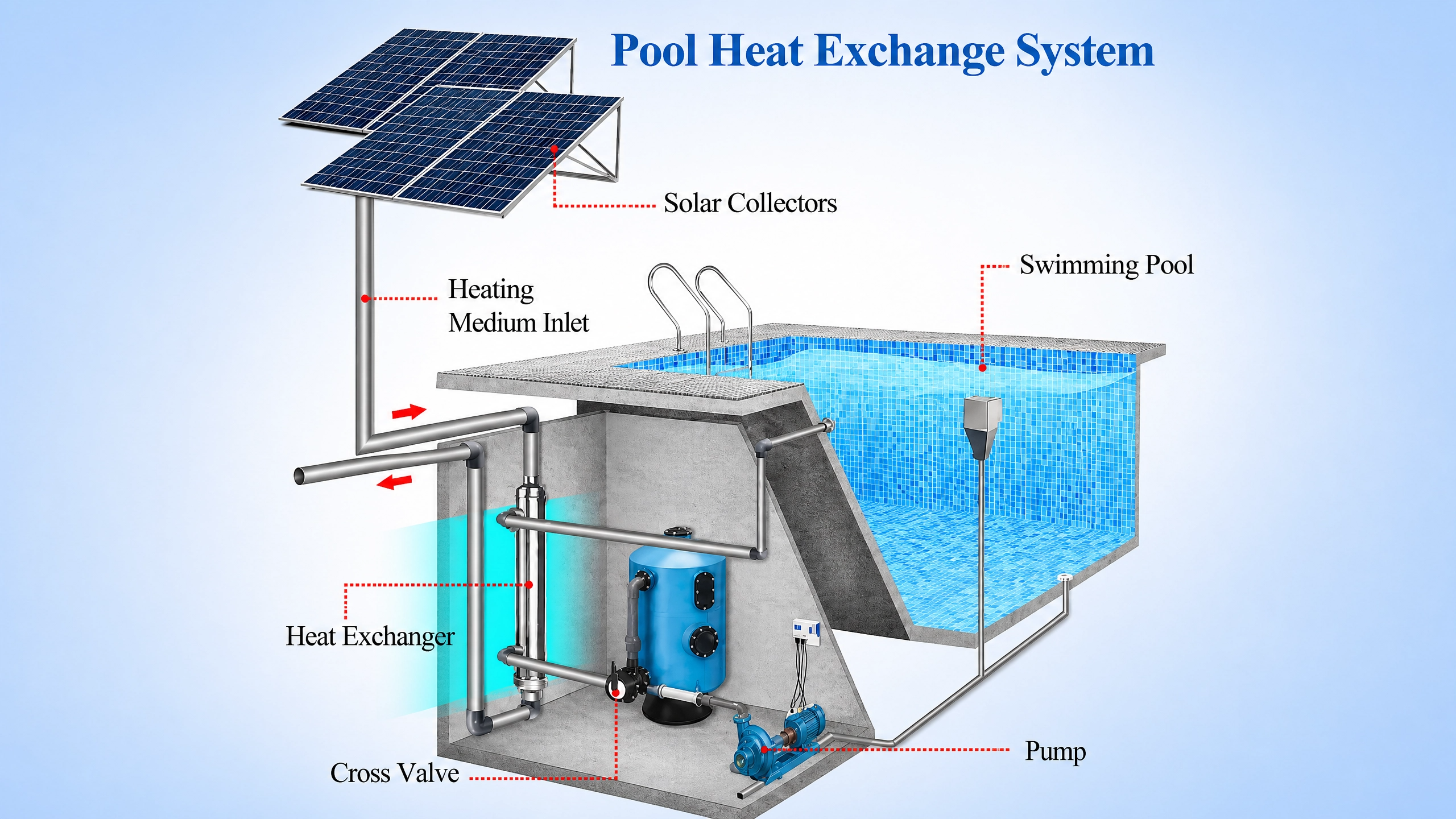
Typical System Design Approach
A swimming pool heating system uses a closed-loop design where a heat exchanger transfers energy between the heating source and pool water without mixing the two circuits. How Pool Heat Exchangers Work
Main components include:
- Heat Source: Boiler, heat pump, solar, or other thermal systems provide heating energy.
- Pool Heat Exchanger: Transfers heat efficiently while protecting pool water and heating equipment.
- Circulation Pump: Maintains required flow for stable heat transfer.
- Controls: Sensors and valves regulate temperature and system operation.
Common System Solution
In practical swimming pool applications, system solutions are typically developed by combining standardized system concepts with site-specific operating conditions.
Rather than relying on a single piece of equipment, swimming pool heating solutions are built around integrated system layouts that balance temperature stability, circulation reliability, and energy efficiency. In many commercial and high-capacity pool systems, Shell and Tube Heat Exchangers are commonly used to support stable thermal transfer and long-term operational performance.
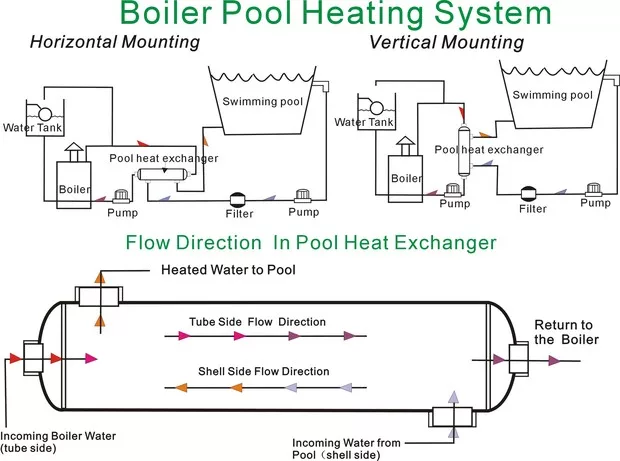
Common system solution concepts include:
Material Selection for Swimming Pool Heat Exchangers
Material Selection for Swimming Pool Heat Exchangers
The material of a swimming pool heat exchanger plays an important role in system performance, durability, and corrosion resistance. The ideal material depends on pool water chemistry, heating source, and operating conditions.
Learn more about material selection for different pool environments in our titanium vs stainless steel pool heat exchangers comparison guide.
| Pool Water Condition | Recommended Material |
|---|---|
| Freshwater Pool | Stainless Steel |
| Saltwater Pool | Titanium |
| High Chlorine Environment | Titanium |
| Commercial Pool | Titanium |
| Residential Pool | Stainless Steel |
Typical Swimming Pool Application Environments
While the fundamental system principles remain consistent, operational priorities vary depending on the application environment.
Swimming pool systems are commonly applied in:
Indoor swimming pools → Application environments: Heating Solutions for Swimming Pools
Outdoor swimming pools → Application environments: Heating Solutions for Outdoor Swimming Pools
Hotels and resorts → Application environments: Heating Solutions for Hotels and Resorts
Fitness centers and wellness facilities → Application environments: Heating Solutions for Public Facilities
Each industry applies the swimming pool system concept based on its own operational scale and usage patterns.
FAQ
A swimming pool heating system maintains pool water at a comfortable, consistent temperature by transferring heat from an energy source into the circulation loop. Depending on the design, it uses a gas heater, electric heat pump, solar collector, or a boiler-supported hydronic network to warm the water efficiently. Key components include controls, valves, pumps, filtration connections, and durable heat transfer equipment sized for the pool's volume and climate conditions. Swimming pool heating systems with shell & tube heat exchangers, pumps, and hydronic components for pools are especially valuable in residential, commercial, and hospitality settings where steady performance, corrosion resistance, and energy-conscious operation matter. Proper system selection ensures year-round comfort, longer swim seasons, and dependable water temperature management.
A swimming pool heating system transfers heat to filtered water before circulating it back into the pool. In most setups, the pool pump pushes water through a filter and then into a heater, where the temperature rises before the water returns through the pool's inlets. Gas heaters burn natural gas or propane to supply quick, powerful heat, while electric heat pumps pull warmth from the surrounding air and use a compressor to transfer it into the water efficiently. Solar pool heaters move water through collector panels, where sunlight warms it naturally before it flows back into the pool. A thermostat or control panel manages the target temperature, and automatic sensors help maintain consistent performance. Proper circulation, insulation, and a fitted pool cover all work together to reduce heat loss and lower operating costs.
Swimming pool heating systems serve facilities that require precise water temperature control, extended swim seasons, and reliable performance. Used for residential and commercial pools, they are common in backyard pools at private residences, hotels, resorts, apartment and condominium complexes, fitness centers, schools, therapy facilities, water parks, and municipal aquatic centers. They are equally valuable for indoor pools that demand steady temperatures year-round and outdoor pools in cooler climates during spring and fall. Pool heaters support lap swimming, family recreation, hospitality amenities, swim instruction, and aquatic therapy. Depending on location and usage demands, property owners install gas heaters, electric heat pumps, or solar systems to match local climate, pool volume, and operational goals.
A swimming pool heating system extends the swim season and keeps the water consistently comfortable, allowing owners to use their pool earlier in spring, later in fall, and during cooler evenings. Maintaining a stable temperature improves relaxation, supports athletic training, and enhances the experience for families and hotel guests alike. Modern models deliver high energy efficiency, minimizing thermal waste while lowering long-term operating costs when properly sized and maintained. Heated water also encourages frequent use, maximizing the overall value of the property investment. Designing efficient swimming pool heating systems to match pool size, local climate, usage patterns, and energy targets delivers dependable comfort, precise control, and lasting convenience.
Choosing a swimming pool heating system depends on your local climate, pool volume, budget, and intended usage frequency. Gas heaters warm water quickly and suit occasional swim schedules or colder climates, though they carry higher operational costs. Electric heat pumps offer exceptional energy efficiency in mild-to-warm climates for daily pool use, despite taking longer to raise temperatures initially. Solar pool heaters provide the lowest running costs and cleanest operation, but their output relies on available sunlight and adequate roof or yard space. Compare upfront installation costs, regional energy rates, maintenance requirements, and expected equipment lifespan. Proper sizing is critical for consistent heating performance; pairing the unit with a thermal pool cover retains heat, reduces evaporation, and significantly lowers overall heating expenses.
Related Products for Swimming Pool Systems
Swimming pool systems rely on coordinated system components to ensure stable temperature control, continuous circulation, and energy-efficient operation.
The following product categories are commonly applied as part of swimming pool heating systems.


