
High-Capacity Modular HVAC System
Large commercial buildings, industrial facilities, and public infrastructure require reliable heating, ventilation, and air conditioning systems to maintain stable indoor environments. As building sizes increase and occupancy patterns become more complex, traditional centralized HVAC systems may struggle to provide flexible capacity and consistent temperature control.
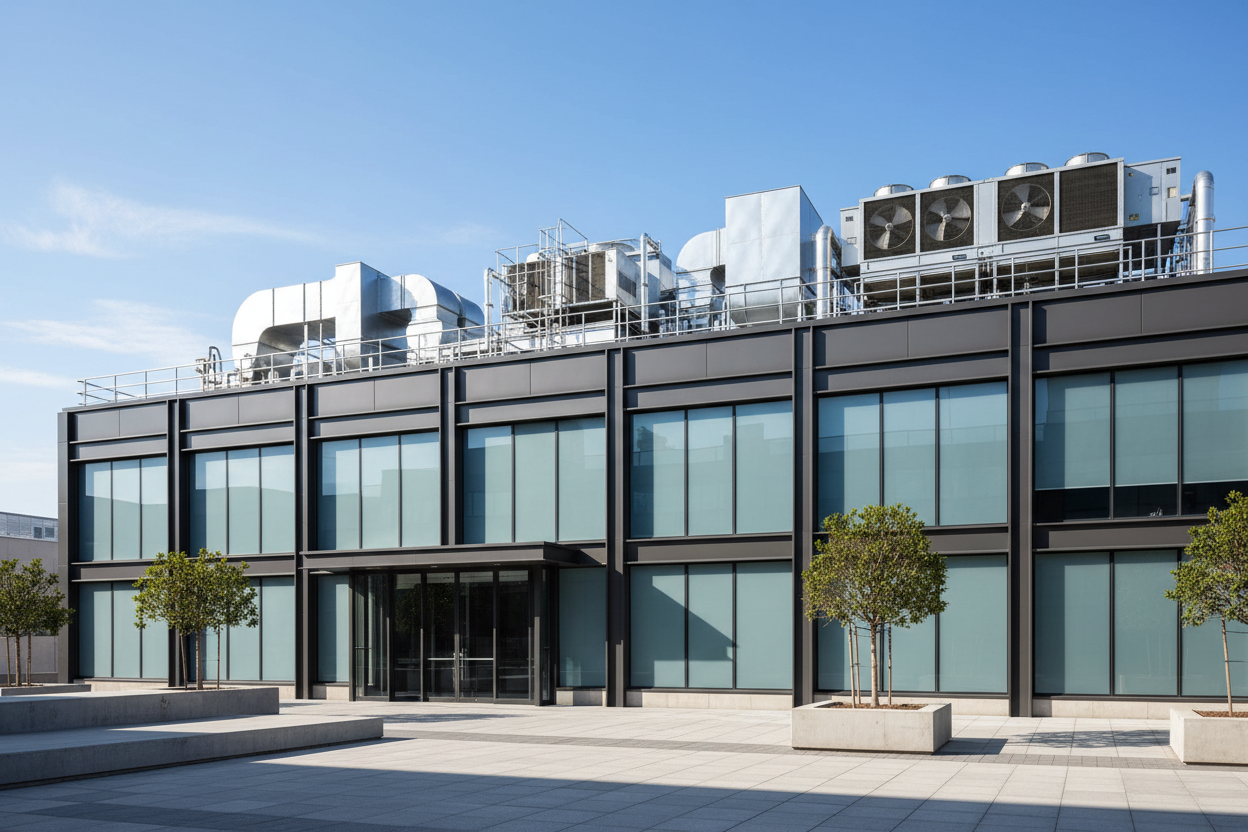
High-capacity modular HVAC systems are designed to support large thermal loads while allowing scalable system expansion. Instead of relying on a single large unit, multiple modular components operate together to distribute heating or cooling capacity across the facility.
A properly configured modular HVAC system provides reliable temperature control, improves system flexibility, and supports continuous operation in facilities with varying thermal demands.
Core Requirements and Challenges
High-capacity HVAC systems must maintain stable indoor environmental conditions while supporting large-scale operation, variable loads, and long operating hours. Achieving consistent performance requires both reliable system design and flexible capacity management.
Core System Requirements
A modular HVAC system must provide stable climate control across large building areas while supporting efficient and reliable system operation.

Operational Challenges
In large-scale HVAC applications, system performance can be affected by changing load conditions, building expansion, and operational complexity.
Load variability:Thermal demand can fluctuate throughout the day due to occupancy changes, equipment usage, and outdoor temperature variations.
System scalability:Facilities often expand over time, requiring additional heating or cooling capacity without major system redesign.
Distribution complexity:Large buildings require consistent air or water distribution across multiple zones and floors. Maintaining balanced system flow is essential for stable performance.
Equipment redundancy and reliability:System reliability is critical in facilities where temperature control directly affects operations, safety, or occupant comfort.
Common System Solutions
A high-capacity modular HVAC system is typically designed as a distributed thermal management system that combines multiple heating or cooling modules with a centralized distribution network.
The system integrates modular components that operate together to provide flexible capacity and consistent temperature control.
The system generally consists of the following functional components:
Heating and cooling modules:Modular chillers, boilers, or heat pump units generate heating or cooling capacity based on system demand.
Heat exchange system:Heat exchangers transfer thermal energy between system loops to support efficient heat distribution.
Circulation system:Pumps circulate chilled or hot water through the network to maintain continuous heat transfer.
Air handling or terminal units:Air handling units or fan coil units deliver conditioned air to occupied spaces.
Control and monitoring system:Control systems regulate temperature, flow rate, and system capacity to maintain stable operation.
This modular architecture allows system capacity to be expanded by adding additional modules as demand increases.
System Working Logic
The working logic of a high-capacity modular HVAC system is based on distributed heat transfer and the coordinated operation of multiple modules to maintain stable indoor temperature conditions. The system functions as a continuous thermal control loop in which heating or cooling capacity is generated, distributed, and regulated according to building demand.
Heating or cooling modules produce thermal capacity based on system load conditions. Circulation pumps then distribute chilled water or hot water through the network to different building zones, ensuring consistent thermal delivery across the facility. Within each zone, air handling units or terminal units transfer heat between the circulating fluid and indoor air to maintain the required temperature and airflow conditions.
Depending on operating mode, excess heat is rejected to an external cooling source, or heat is supplied to indoor spaces to maintain comfort and operational stability. The conditioned fluid then returns to the central system, where the cycle repeats through continuous circulation. This ongoing heat transfer and recirculation process ensures stable temperature control and reliable HVAC system performance.
Suitable Product Types and System Configuration
Several types of thermal management equipment are commonly used to support high-capacity modular HVAC systems. The specific configuration depends on system size, building load, and operational requirements.
Common equipment used in this system includes:
Plate Heat Exchangers:Used to transfer heat between primary and secondary loops in modular HVAC systems.
Shell and Tube Heat Exchangers:Suitable for high-capacity heating and cooling systems requiring durable and stable performance.
Circulation Pumps:Maintain continuous fluid flow and support stable heat distribution across the building.
Air Handling Units (AHU):Deliver conditioned air to occupied spaces and maintain indoor temperature and airflow conditions.
Expansion Tanks:Stabilize system pressure and accommodate thermal expansion of the circulating fluid.
Control Valves and Sensors:Regulate flow rate and temperature to ensure stable system operation.
These components work together to provide scalable capacity, reliable temperature control, and stable system performance.
Representative Application Environments
While system design principles remain consistent, operational conditions and capacity requirements may vary depending on building size, occupancy patterns, and infrastructure complexity.
Common application environments include:
Commercial office buildings:(link to Industries → Heating Solutions for Office Buildings)
Shopping centers and retail complexes:(link to Industries → Heating Solutions for Public Facilities)
Hospitals and healthcare facilities:(link to Industries → Healthcare)
Hotels and hospitality facilities:(link to Industries → Hospitality)
Airports and transportation terminals:(link to Industries → Transportation Infrastructure)
Industrial plants and manufacturing facilities:(link to Industries → Industrial Manufacturing)
Educational campuses and public buildings:(link to Industries → Heating Solutions for Office Buildings)
FAQ
A high-capacity modular HVAC system uses multiple interconnected units to heat and cool large buildings, campuses, and industrial facilities with varying thermal demands. Rather than relying on a single oversized unit, it combines smaller modules that can be added, staged, or serviced independently to match load requirements efficiently. This configuration improves scalability, energy efficiency, and operational redundancy—if one module requires service, the remaining units continue running. High-capacity modular HVAC systems also simplify future expansions, enable precise load matching, and improve zone control, making them a practical choice for facilities that require reliable climate control and minimal downtime.
A modular HVAC system combines several self-contained heating and cooling units into a single coordinated network. Each module houses core components—including compressors, fans, coils, and controls—and scales capacity by cycling individual units on or off according to real-time temperature demand. Staged operation optimizes energy use by preventing equipment from running at full output during low-demand periods. The modular architecture also simplifies installation, allowing operators to add units as a facility grows. Maintenance is equally straightforward, as technicians can service a single module without shutting down the entire system. This provides flexible climate control and dependable performance for commercial spaces, schools, offices, and other sites with variable occupancy patterns.
Modular HVAC systems serve residential, commercial, and industrial facilities that require flexible, scalable climate management. They are common in office buildings, schools, hospitals, hotels, apartment complexes, retail centers, and restaurants, where heating and cooling demands change as spaces are reconfigured. Manufacturing plants, warehouses, and data centers rely on them for precise temperature regulation and equipment uptime. These systems are also well suited for new construction, retrofits, temporary structures, and phased development projects because facilities can install units in stages. Their compact footprint fits tight mechanical spaces, while their adaptable layout lets building managers customize heating and cooling capacity for specific zones.
Modular HVAC systems deliver scalable heating and cooling for residential and commercial properties by linking multiple units into a unified system. This approach allows facilities to expand capacity incrementally, reducing initial capital expenditures compared to installing a large traditional system upfront. By operating only the modules required at any given moment, these setups reduce energy consumption, lower utility bills, and minimize equipment wear. Installation is faster and less disruptive because technicians can add components in sections. System redundancy is another key benefit: if one module fails or requires maintenance, the remaining units maintain indoor comfort. Ultimately, modular design offers easier servicing, precise zoning, and reliable long-term performance.
To select a high-capacity modular HVAC system, match total load requirements, zoning demands, and long-term expansion plans with equipment that stages output efficiently during partial loads. Prioritize modules featuring high turndown ratios, variable-speed compressors, and advanced controls that balance energy use and redundancy across large spaces. Ensure the system integrates with your building automation platform, supports remote monitoring, and offers accessible components for quick servicing. Evaluate seasonal efficiency ratings, sound output, electrical infrastructure, and airflow design, particularly in facilities with fluctuating occupancy. Finally, choose manufacturers with established reliability, local parts availability, and strong warranty support, and work with a qualified HVAC engineer to verify load calculations, ventilation targets, and structural constraints.