
Compact Installation HVAC System
Heating, ventilation, and air conditioning (HVAC) systems are often installed in locations where available space is limited, such as equipment rooms, mechanical closets, rooftop units, and modular building systems. In these situations, maintaining efficient thermal management within a compact installation footprint becomes a critical system design requirement.
Unlike large centralized installations, compact HVAC systems must deliver reliable heating or cooling performance while operating within restricted physical space and limited installation flexibility. Poor system layout or oversized equipment can lead to reduced airflow, inefficient heat transfer, and increased maintenance difficulty.
A properly designed compact installation HVAC system enables efficient thermal control, reliable system operation, and flexible integration into space-constrained installations.

Core Requirements and Challenges
Compact HVAC installations must maintain system performance while operating within physical and operational constraints. Achieving reliable heating or cooling in limited installation space requires careful system design and component coordination.
Core System Requirements
A compact installation HVAC system must provide stable thermal performance while maintaining efficient operation within a reduced physical footprint.

Operational Challenges
In addition to performance requirements, compact HVAC systems must address practical challenges associated with limited installation space and system integration.
- Limited installation space:Restricted physical space can limit equipment size, piping layout, and airflow distribution, making system configuration more complex.
- Equipment integration constraints:Multiple system components must be arranged within a confined area while maintaining proper connections and safe operation.
- Airflow and heat dissipation limitations:Reduced clearance around equipment can affect airflow patterns and heat transfer efficiency.
- Installation flexibility:Compact systems must adapt to different building layouts and mechanical configurations without compromising system performance.
Common System Solutions
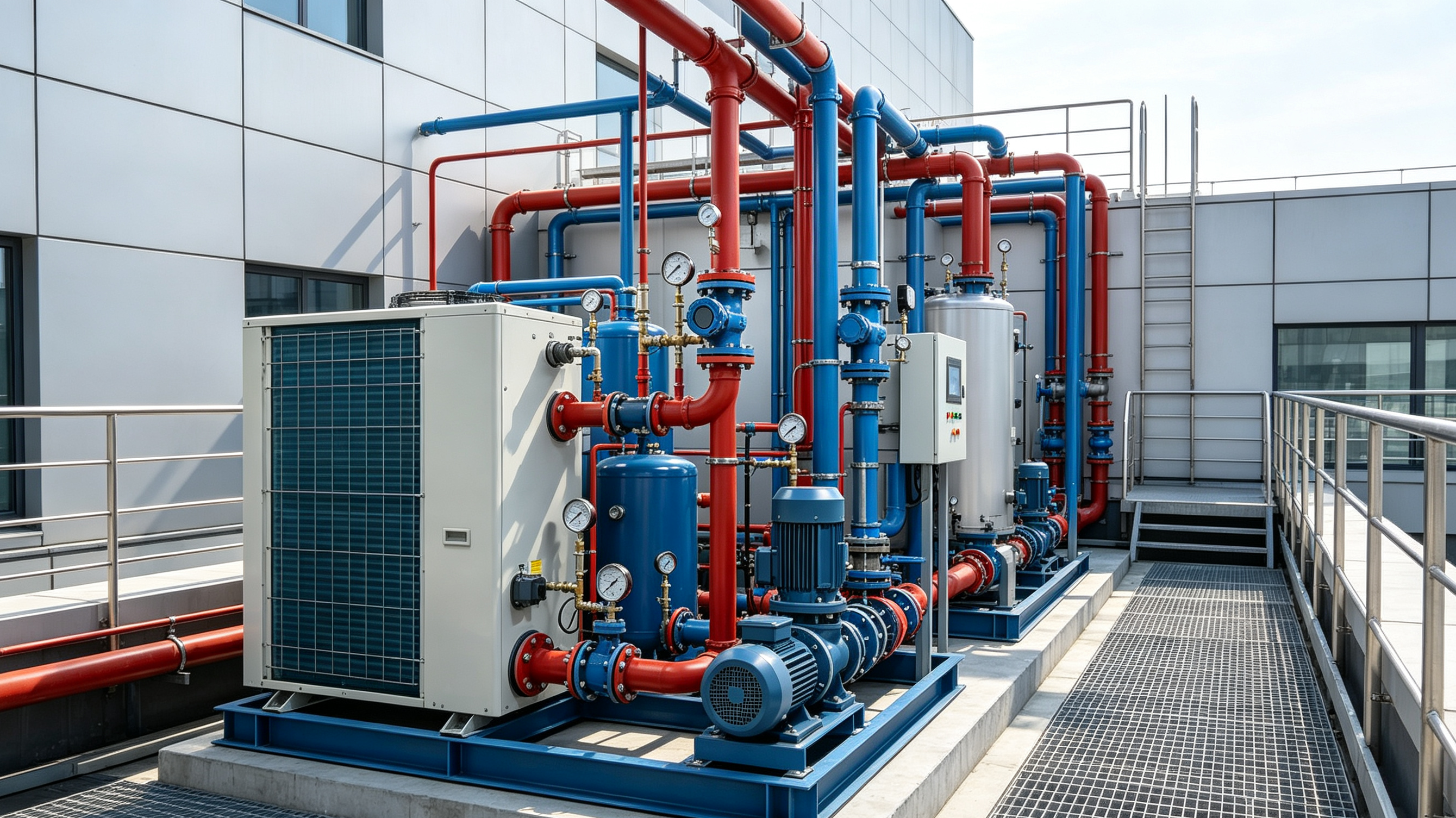
A compact installation HVAC system is typically designed to deliver efficient heating or cooling performance while minimizing equipment footprint and simplifying system integration.
The system generally consists of the following functional components:
Heat source or cooling source:The system may use a boiler, heat pump, or chiller to generate heating or cooling capacity.
Heat exchanger:Heat exchangers transfer thermal energy between system circuits while allowing flexible system configuration in limited space.
Circulation system:Circulation pumps maintain continuous fluid flow and ensure stable heat transfer throughout the system.
Distribution system:Piping and control valves distribute heated or cooled fluid to terminal units such as air handlers, fan coils, or radiant systems.
Control and monitoring system:Sensors and controllers regulate temperature, flow rate, and system operation to maintain stable performance.
This system architecture enables reliable HVAC operation while supporting efficient installation in space-constrained environments.
System Working Logic
The working logic of a compact installation HVAC system is based on controlled heat transfer and continuous fluid circulation within a space-efficient system layout. The system operates as a closed-loop thermal management cycle that continuously delivers heating or cooling capacity while maintaining stable temperature control.
During operation, a heating or cooling source produces thermal energy required for building temperature regulation. This thermal energy is transferred through a heat exchanger to the system distribution loop, where circulating fluid carries the heat to terminal units such as air handlers or fan coil units. These terminal units release or absorb heat to maintain the desired indoor temperature conditions.
After transferring thermal energy, the fluid returns to the heat source or heat exchanger to repeat the operating cycle. This continuous circulation process ensures reliable heat transfer, stable system performance, and efficient operation within compact installation environments.

Suitable Product Types and System Configuration
Several types of equipment are commonly used to support compact installation HVAC systems. The selection of components depends on system capacity, installation constraints, and operational requirements.
Common equipment used in this system includes:
Plate Heat Exchangers:Used for efficient heat transfer in systems where space efficiency and compact design are important.
Brazed Plate Heat Exchangers:Provide high heat transfer performance within a small footprint, making them suitable for compact HVAC installations.
Circulation Pumps:Maintain continuous fluid flow and support stable system operation.
Expansion Tanks:Stabilize system pressure and accommodate thermal expansion of system fluid.
Control Valves and Sensors:Regulate system flow and temperature to ensure reliable performance.
These components work together to support efficient system operation while minimizing installation space requirements.
Representative Application Environments
While system design principles remain consistent, compact installation HVAC systems are commonly used in facilities where space efficiency and flexible installation are important.
Common application environments include:
Rooftop HVAC units:(link to Industries → Heating Solutions for Office Buildings)
Modular or prefabricated buildings:(link to Industries → Modular Construction)
Residential and commercial utility spaces:(link to Industries → Heating Solutions for Office Buildings)
District heating substations:(link to Industries → District Energy Systems)