Choosing between air-cooled and water-cooled chillers isn’t just about price or size; it's also about efficiency. Each type performs differently depending on space, climate, and cooling demand. Understanding how components like a shell and heat exchanger or an air-to-water heat exchanger function will help you decide which system fits your project requirements best.
How air-cooled and water-cooled chillers work
Chillers are essential in many industrial, commercial, and HVAC systems because they remove heat and help maintain a regulated temperature. Both air-cooled and water-cooled chillers serve the same basic purpose: to remove heat from a process or building. But the way they do it—and how they interact with components like a shell and heat exchanger—varies significantly.
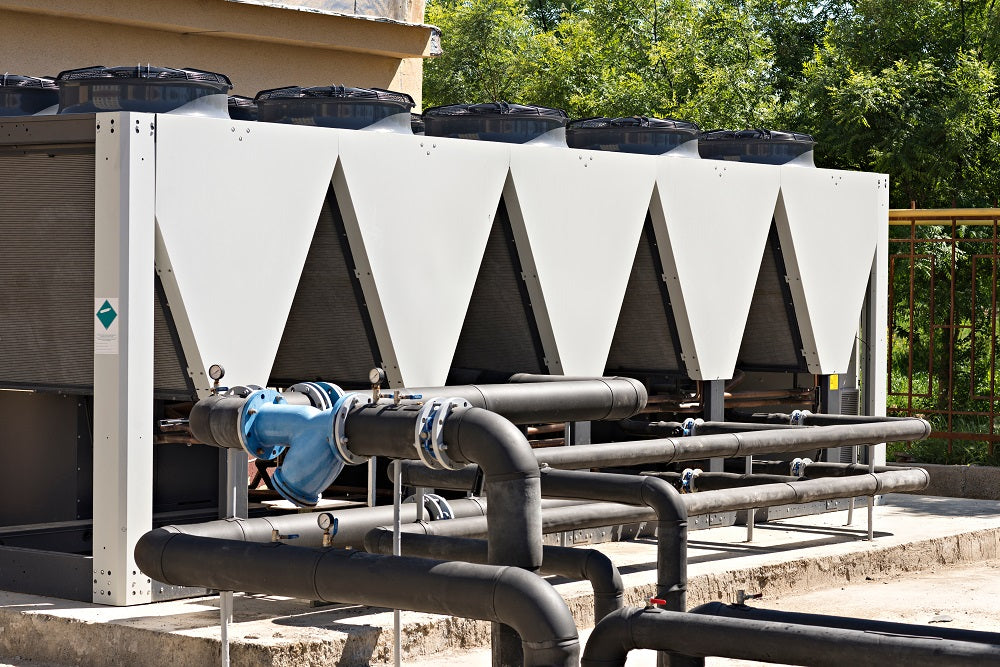
Air-cooled chillers rely on ambient air. These systems use fans to blow air across condenser coils, where heat is expelled. It’s a direct method that works well in open, ventilated environments and doesn’t require much infrastructure. On the other hand, water-cooled chillers utilize a closed loop in which heat is transferred into water and then carried to a cooling tower. The tower releases the heat into the air through evaporation.
Discover our most popular product categories – find what you need today!
- Air to Water Heat Exchangers
- Water to Air Heat Exchangers
- Plate Heat Exchangers
- Oil Coolers & Intercoolers
- Tankless Water Heaters
This approach tends to be more efficient in consistent or high-load environments. Systems involving a water-to-air heat exchanger or an air-to-water heat exchanger are often part of the design, depending on how heat needs to move within your setup.
Each type of chiller comprises components that manage thermal exchange, including compressors, condensers, evaporators, and expansion valves. But when it comes to core heat transfer, the presence of a tube and shell heat exchanger in many water-cooled units plays a crucial role in regulating temperatures effectively under large loads.
Choosing the right system often starts with understanding how each one manages heat differently. This also affects how the system behaves in real-world scenarios: for instance, sudden ambient temperature changes can impact air-cooled systems more than water-cooled ones. If your environment is stable or your load doesn’t vary much, either chiller type might work. However, if you expect changing demands or work in a high-load facility, you’ll need to consider how heat is handled within the shell and heat exchanger, as well as across all other system components.
Installation and space requirements
Installation logistics are among the first considerations when comparing air-cooled and water-cooled chillers. These systems differ not only in technical design but also in the amount of space they require and where they can be located.
Air-cooled chillers are often installed outside the facility. Because they rely on ambient air to discharge heat, they require good ventilation and enough clearance around them. Their compact footprint and reduced need for cooling towers or additional pumps make them a more suitable choice for buildings with limited mechanical room space. For setups that use a water-to-air heat exchanger, the outdoor design offers convenience and faster deployment.
Water-cooled chillers, however, require more infrastructure. The chiller itself is typically installed indoors, often in a dedicated mechanical room. It is connected to a cooling tower, typically located on the roof or in a separate outdoor area. The cooling tower adds complexity but allows for more control over cooling performance. Systems using a tube and shell heat exchanger are common in these setups, and they require sufficient space for proper installation, access, and maintenance.
Another consideration is access to utilities. Air-cooled chillers use electrical power and move air across coils using fans. Water-cooled chillers require water connections, drainage, and possibly a water treatment system. This involves evaluating local building codes, piping layouts, and the availability of water supply before committing to a water-cooled system.
Finally, weight is another factor. The shell and heat exchanger in water-cooled systems tend to be heavier and bulkier, which could affect installation in older buildings or upper floors. In contrast, air-cooled systems are lighter and easier to place with a crane or on a structural pad.
The choice here depends on your facility layout, the availability of installation space, and the amount of time and effort you’re prepared to invest in system setup.
Efficiency in different environments
Chiller efficiency can vary dramatically based on your operating environment. This includes not only the external climate but also the steadiness of your cooling demand throughout the day and year. That’s why choosing between an air-cooled and a water-cooled chiller should always take local conditions into account.
Air-cooled chillers are most efficient in moderate or cooler climates. Because they discharge heat directly into the surrounding air, their performance can decrease as the ambient temperature rises. In very hot areas, these systems work harder to release heat, increasing energy consumption. Still, they’re simple and often cost-effective to operate in regions with favorable climates.
In contrast, water-cooled chillers tend to perform consistently regardless of outdoor air temperature. They rely on cooling towers that utilize evaporation to discharge heat, enabling them to maintain optimal performance even in the hottest conditions. This is especially helpful in industrial or commercial facilities with high and continuous cooling demands. A properly designed air-to-water heat exchanger system contributes to this stability by efficiently transferring heat from the refrigerant to the water before it is sent to the cooling tower.
It’s worth noting that water-cooled systems often offer a higher Coefficient of Performance (COP), meaning they consume less power for the same amount of cooling, especially when operating under a heavy or continuous load. The design of the tube and shell heat exchanger in these units often allows for smoother and more efficient heat transfer, which directly impacts long-term operating costs.
That said, air-cooled chillers can still be a good fit for smaller buildings or short-cycle operations where simplicity is more valuable than efficiency. In regions with lower average temperatures or seasonal operation, the added cost and complexity of water-cooled chillers may not be justified.
Maintenance needs and long-term upkeep
When it comes to long-term maintenance, there are big differences between air-cooled and water-cooled chillers. These differences affect everything from routine checks to the overall lifespan of the system.
Air-cooled chillers are generally easier to maintain. Since they don’t require cooling towers, water pumps, or water treatment systems, the list of regular service tasks is shorter. You’ll need to clean coils, check fan motors, and monitor refrigerant levels—but overall, the system is more straightforward. Many units also integrate a shell and heat exchanger directly into a compact design that’s accessible for technicians.
Water-cooled chillers involve more complexity. They require monitoring of both the chiller and the external cooling tower. The tower itself must be cleaned regularly to avoid scale buildup, corrosion, and biological growth. Water must be treated to prevent fouling or damage to internal components. If your system includes a tube and shell heat exchanger, you’ll need to inspect and clean the tubes on a schedule to avoid blockages or performance loss.
Over time, however, water-cooled systems tend to last longer than air-cooled systems, particularly in well-maintained facilities. Because they operate under more stable thermal conditions and aren’t exposed to outdoor weather, their internal components suffer less wear.
It’s also important to consider any specialized components in your system. If you’re using an engine oil cooler integrated with your chiller for industrial machinery, regular oil-side maintenance becomes an added task. Keeping both sides of the heat exchanger (oil and coolant) clean ensures proper performance and safety.
In terms of planning, air-cooled systems require lower service effort, while water-cooled systems offer a longer lifespan but higher service demands. Knowing your maintenance resources and capabilities will help you choose the right system for long-term success.
Cooling capacity and load fluctuations
Chillers are not one-size-fits-all; depending on how your cooling load changes throughout the day or week, one system may outperform another. This is where the technical capabilities of air- and water-cooled systems come into focus.
Air-cooled chillers typically have a limited capacity and are best suited for stable or smaller-scale applications. They handle steady, predictable cooling loads well, especially in areas where cooling is only needed seasonally or intermittently. Their air-to-water heat exchanger sections are generally smaller and optimized for light to medium duty use.
In contrast, water-cooled chillers are built to manage large, variable, or continuous cooling loads. Their systems can adapt more efficiently to changing conditions, thanks in part to the flexibility of water as a heat transfer medium. The tube and shell heat exchanger plays a key role here—it allows the system to exchange heat efficiently, even under heavy stress.
This makes water-cooled systems a better choice for:
- Manufacturing plants run 24/7
- Large office buildings or hospitals
- Data centers with strict temperature control requirements
These environments require precise and reliable cooling regardless of fluctuations in demand. Water-cooled chillers can handle that better due to their design and integration with larger mechanical systems.
If your operation also involves machinery that produces heat—such as generators, compressors, or engines—then adding an engine oil cooler to your system can be an effective way to manage excess thermal load. This is another point in favor of water-cooled setups, which offer greater flexibility in customization.
So when evaluating your expected cooling profile, ask: How often does the load change? Is it constant, or does it spike? The answers will guide you toward the system that can handle those changes without performance loss.
Water availability and operational costs
Your chiller system is only as good as the resources available to run it. One of the most overlooked—but crucial—factors when choosing between air-cooled and water-cooled chillers is water availability and the long-term operational costs.
Water-cooled chillers, by design, require a continuous water supply. The cooling tower uses water for evaporation, and the system needs to replace water lost to drift and blowdown. If you’re in an area with limited water access or where water is expensive, this can become a significant operating cost.
Conversely, air-cooled systems don’t consume water. They rely solely on air movement and mechanical fans, which makes them ideal in places where water is scarce or regulated. Systems that use a water-to-air heat exchanger internally still depend on closed-loop cooling, but the loop itself doesn’t require the same level of consumption as an open cooling tower system.
Cost-wise, air-cooled chillers have higher electrical demand because fans must run continuously to expel heat. However, in cooler climates or seasonal-use facilities, this additional energy use may be negligible. On the other hand, water-cooled chillers consume less power but incur additional costs for water treatment, pumping, and tower operation.
If energy prices are high but water is affordable, water-cooled systems often offer lower lifecycle costs. In areas where water is costly or limited, air-cooled becomes the practical choice—even if it’s slightly less efficient.
There’s also hybrid potential. Some systems incorporate both air and water cooling using a shell and heat exchanger that supports multiple loops. These setups offer flexibility but come with increased complexity and a higher initial cost.