A water to air heat exchanger provides an effective way to transfer heat from a hot water source into an existing forced air heating system. By combining a copper tube coil with aluminum fins, this type of finned coil heat exchanger transfers thermal energy from circulating hot water to moving air, making it suitable for residential, commercial, and hydronic heating applications.
Whether you are upgrading a furnace, connecting an outdoor wood boiler to a ductwork system, or adding supplemental heating to a building, choosing the right coil configuration is important for reliable system operation.
In this guide, we explore the construction, key features, available models, and common applications of water to air heat exchangers to help you identify a suitable solution for your heating system.
1. How Does a Water to Air Heat Exchanger Work?
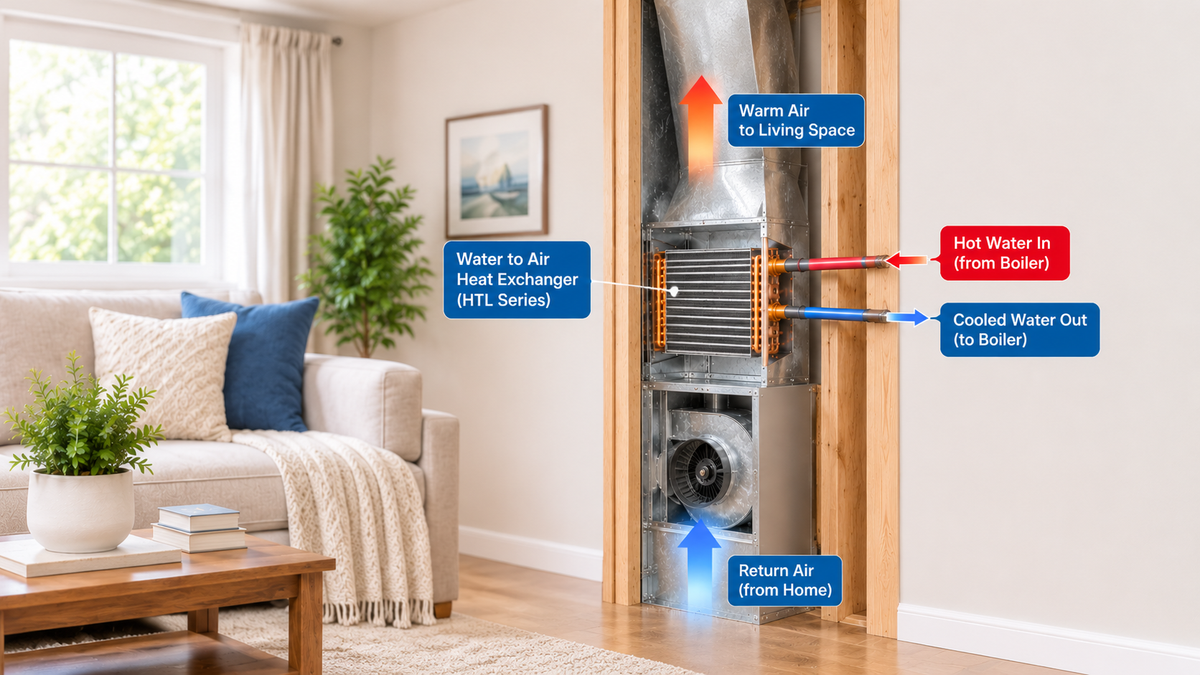
A water to air heat exchanger transfers heat between two separate fluid streams: hot water flowing through copper tubes and air passing across the finned coil.
The operating process is straightforward:
-
Hot water from a boiler, outdoor wood furnace, or other heating source enters the heat exchanger through the inlet connection.
-
The water circulates through the copper tube coil, transferring heat to the surrounding tube walls.
-
Aluminum fins conduct and distribute heat across a larger surface area.
-
A blower or fan moves air across the finned surface, allowing the air to absorb heat.
-
The heated air enters the ductwork or designated space, while the cooled water returns to the heating source.
This design allows a hydronic heating system to work with forced air distribution without requiring the hot water to circulate through the air distribution system itself.
A finned coil heat exchanger is particularly useful when a heating system needs to transfer energy from a water-based source into an air-handling system.
2. Copper Tubes and Aluminum Fins: Key Construction Features
The performance and durability of a water to air heat exchanger depend on its internal coil construction and material selection.
Copper Tube Coil
The water circuit uses 3/8-inch copper tubes arranged in multiple rows.
Copper offers good thermal conductivity, allowing heat to transfer efficiently from the circulating water to the fin assembly. Its smooth inner surface also supports fluid flow through the coil.
The copper tubes are connected through copper return bends to form a continuous water circuit.
Aluminum Wave Fins
The air-side surface uses aluminum wave fins with a fin density of 12 fins per inch (FPI).
These fins increase the available heat transfer surface area and help distribute heat from the copper tubes to the passing air.
The wavy fin design also creates an extended heat transfer surface across the coil.
Coil Frame and Connections
The finned coil is assembled within a metal frame that supports the coil structure and facilitates installation.
The widened inlet and outlet connections provide access to the water circuit. Proper piping support is important during installation to prevent unnecessary stress on these connections.
Epoxy-Coated Fin Option
An epoxy coating is available on the applicable product configuration. It provides an additional protective surface for the fins and can help resist moisture-related deterioration.
For installations exposed to humid conditions, confirm the coating configuration and environmental suitability before ordering.
3. Available Water to Air Heat Exchanger Models
Alfa Heating offers several water to air heat exchanger sizes to accommodate different heating requirements and installation spaces.
The available models include five configurations, with nominal heating capacities ranging from 80,000 to 160,000 BTU/h under the stated rating conditions.
| Model | Capacity (BTU/h) | Height (A) | Width (B) | Depth (C) |
|---|---|---|---|---|
| HTL16X16 | 80,000 | 16" | 16" | 3.5" |
| HTL16X18 | 100,000 | 16" | 18" | 3.5" |
| HTL18X18 | 120,000 | 18" | 18" | 3.5" |
| HTL18X20 | 140,000 | 18" | 20" | 3.5" |
| HTL20X20 | 160,000 | 20" | 20" | 3.5" |
Capacity ratings are based on a boiler water temperature of 180°F. Actual heating output depends on operating conditions, including water temperature, water flow, entering air temperature, and airflow.
How to Compare the Available Models
When comparing models, consider both the required heating output and the available installation space.
-
HTL16X16 Water to Air Heat Exchanger: A compact option for systems requiring a nominal 80,000 BTU/h capacity.
-
HTL16X18 Water to Air Heat Exchanger: Provides a nominal 100,000 BTU/h capacity with a slightly wider coil.
-
HTL18X18 Water to Air Heat Exchanger: A medium-size option rated at 120,000 BTU/h.
-
HTL18X20 Water to Air Heat Exchanger: Offers a nominal 140,000 BTU/h capacity for higher heating requirements.
-
HTL20X20 Water to Air Heat Exchanger: The largest model in this listed series, rated at 160,000 BTU/h.
The model dimensions should be checked against the available furnace plenum, air handler, or ductwork opening before installation.
4. Common Applications of Water to Air Heat Exchangers
A water to air heat exchanger can connect a hydronic heating source with an air distribution system. Its practical applications depend on the heating source, airflow arrangement, and installation requirements.
Outdoor Wood Boiler and Wood Furnace Systems
An outdoor wood boiler can supply heated water to a water to air heat exchanger installed inside a forced air furnace or ductwork system.
The hot water circulates through the copper coil, while the existing furnace blower moves air across the aluminum fins.
This arrangement allows heat generated by an outdoor wood boiler to be distributed through an existing forced air heating system.
Related searches:
-
heat exchanger for outdoor wood boiler
-
outdoor wood boiler water to air heat exchanger
-
wood boiler water to air heat exchanger
Forced Air Furnace and HVAC Systems
A water to air heat exchanger can be installed in a compatible furnace plenum or air handler to transfer heat from a boiler or hydronic heating circuit into the building's air distribution system.
Typical applications include:
-
Residential forced air heating
-
Commercial HVAC heating systems
-
Existing furnace upgrades
-
Ductwork-based hydronic heating
The installation must provide sufficient airflow across the coil and accommodate the unit's dimensions and water connections.
Greenhouse Heating
For greenhouse applications, a water to air heat exchanger can be connected to a boiler-based hot water system.
A fan or forced air arrangement moves heated air into the greenhouse, helping distribute warmth throughout the growing area.
The required heating capacity depends on greenhouse size, insulation, outdoor temperatures, and the desired indoor temperature.
Marine and Other Specialized Systems
Finned coil heat exchangers can also be considered for certain marine and specialized air-handling applications where water-to-air heat transfer is required.
However, the operating environment, corrosion exposure, water quality, pressure, and temperature must be evaluated before selecting a suitable coil. Standard configurations should not be assumed suitable for marine environments without confirming material and protection requirements.
5. Important Specifications Before Purchasing a Finned Coil Heat Exchanger
Beyond the nominal heating capacity, several product specifications should be reviewed before purchasing.
| Specification | Product Information |
|---|---|
| Tube Material | Copper |
| Tube Diameter | 3/8 inch |
| Tube Rows | 3 rows |
| Fin Material | Aluminum |
| Fin Type | Wave fin |
| Fin Density | 12 fins per inch |
| Tube-Side Design Rating | 175 psig at 350°F |
| Minimum Working Temperature | 32°F |
| Maximum Working Temperature | 350°F |
| Design Pressure | 175 psi |
| Test Pressure | 263 psi |
| Connection Size | Refer to the selected model's product specifications |
Check the Water Temperature and Pressure
The hot water temperature and operating pressure must remain within the product's specified limits.
The stated tube-side rating is 175 psig at 350°F. The system should also be equipped with appropriate pressure and temperature controls.
Check the Connection Size and Piping Layout
Confirm the inlet and outlet connection sizes, pipe orientation, and available installation clearance before purchasing.
The inlet and outlet pipes should not be used as structural supports. Use suitable mounting brackets or other approved support arrangements to secure the heat exchanger.
Check Airflow Compatibility
The air-side configuration must be compatible with the existing blower or fan.
Insufficient airflow can affect heat transfer and may cause undesirable operating temperatures. Check the furnace or air handler specifications to ensure the coil can be integrated correctly.
6. Installation Considerations for Water to Air Heat Exchangers
Correct installation helps maintain stable operation and reduces unnecessary stress on the coil and piping.
Consider the following points:
1. Follow the specified piping arrangement.
For hot water applications, the manufacturer's recommended arrangement uses a lower inlet and an upper outlet. Do not interchange the connections without confirming the correct flow arrangement for the specific installation.
2. Provide independent mechanical support.
The inlet and outlet pipes should not carry the weight of the heat exchanger. Install suitable fixing brackets to support the unit securely.
3. Confirm the installation dimensions.
Check the coil height, width, depth, connection positions, and surrounding clearance before installation.
4. Maintain suitable water flow and air circulation.
The water circuit and air distribution system should operate within the design requirements of the selected unit.
5. Inspect the system before operation.
Check the piping connections, mounting, water circuit, and air-side clearance before starting the heating system.
For installations involving existing furnaces or boilers, consult a qualified HVAC or hydronic heating professional when necessary.
7. How to Choose the Right Water to Air Heat Exchanger for Your Project
Selecting a suitable finned coil heat exchanger involves more than matching a model's nominal BTU rating.
Before placing an order, prepare the following information:
-
Required heating capacity or estimated heat load
-
Hot water supply temperature and return temperature
-
Available water flow rate
-
Available water pressure and acceptable pressure drop
-
Airflow or blower specifications
-
Installation opening dimensions
-
Water inlet and outlet connection requirements
-
Heating source, such as a boiler or outdoor wood furnace
If you are replacing an existing coil, providing its dimensions, connection layout, and model information can also help simplify product matching.
Not sure which model fits your application? Send your operating conditions and installation dimensions to Alfa Heating. Our team can help review the available configurations and identify a suitable option.
Find the Right Finned Coil Heat Exchanger for Your Heating System
Whether you are upgrading an existing furnace, integrating an outdoor wood boiler, or building a hydronic forced air heating system, selecting the right water to air heat exchanger is essential for reliable heat transfer.
Alfa Heating offers multiple HTL series configurations with copper tube coils and aluminum wave fins to accommodate different installation sizes and heating requirements.
FAQ
A water to air heat exchanger describes the heat transfer function: transferring heat from circulating water to air.
A finned coil heat exchanger describes the construction, which uses tubes and extended fins to increase the heat transfer surface area.
Many water to air heat exchangers use a finned coil design.
Yes. A compatible water to air heat exchanger can transfer heat from an outdoor wood boiler's hot water circuit into a forced air furnace or ductwork system.
The water temperature, pressure, flow rate, and coil capacity should be checked before installation.
The listed configuration uses 3/8-inch copper tubes and aluminum wave fins, with a fin density of 12 fins per inch.
An epoxy-coated fin configuration is also available for applicable models.
A suitable water to air heat exchanger should be selected based on the required heating output, water supply temperature, water flow rate, and airflow. The available heating capacity also depends on the operating conditions of the system. For the best match, compare your system's heating requirements with the rated capacity of the HTL series models. If you are unsure which model to choose, contact Alfa Heating with your system specifications for assistance.
A compatible unit may be installed in an existing forced air furnace or air handler, provided that the installation space, airflow, water connections, and operating conditions meet the product requirements.
Always verify the dimensions and installation arrangement before ordering.