A manifold controls water flow, balance, and zoning in underfloor heating. The right choice affects comfort, installation quality, servicing access, and long-term system stability in both new builds and renovations.
From the article, you will learn:
- What a manifold does in an underfloor heating installation
- Which manifold components affect control, balance, and servicing
- How loop count influences sizing and future expansion
- When stainless steel or brass construction makes more sense
- Why flow meters and actuators matter for zoning accuracy
- Which mistakes create uneven room temperatures
- How the installation location affects access and maintenance
- What to compare before selecting a manifold for a residential project
- How to match manifold choice with the wider heating layout
What a manifold does in an underfloor heating layout
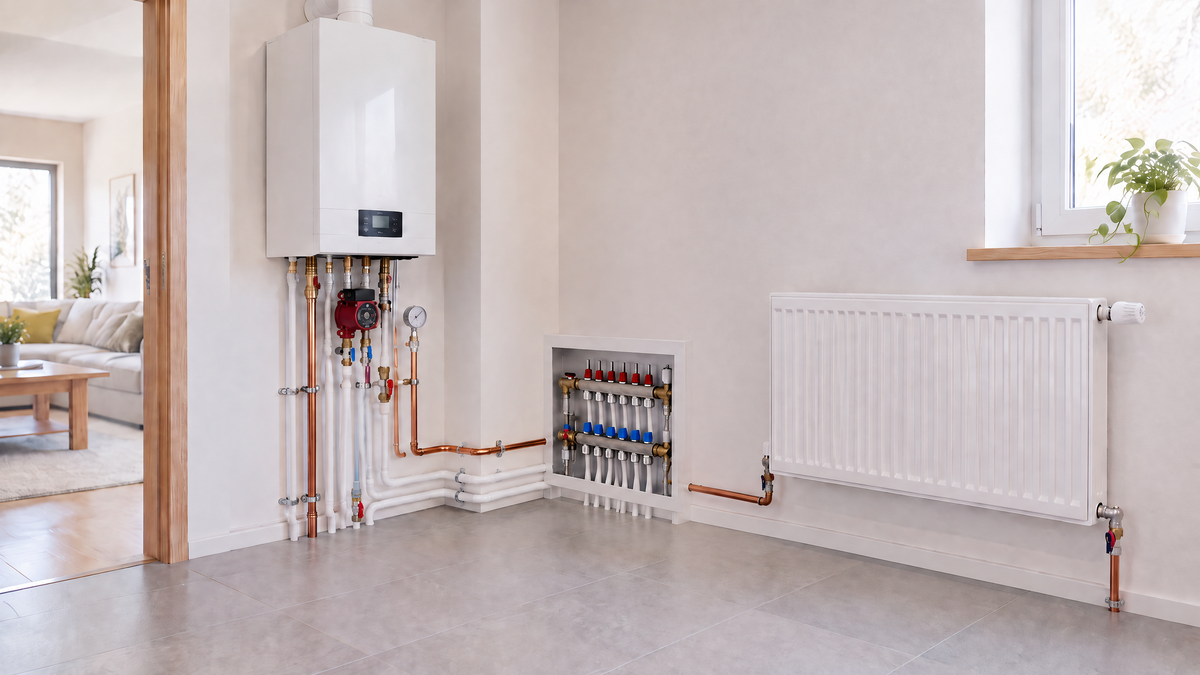
An underfloor heating manifold is the control point that distributes heated water from the heat source to each floor loop and returns cooler water to be reheated. A correct manifold selection supports even heat delivery, room-by-room adjustment, and stable hydraulic balance. In practice, the manifold includes key components such as isolation valves, flow meters, drain points, air vents, and, often, thermostatic or actuator connections. Each part has a direct effect on system operation and maintenance. A poorly matched manifold can cause uneven loop performance, longer commissioning time, and difficult servicing. A well-matched unit keeps each circuit measurable and adjustable, which matters in both compact residential systems and larger multi-zone properties.
The first factor to check before choosing a manifold
The main answer to how to choose an underfloor heating manifold starts with project data, not product appearance. The installer or specifier should confirm the number of loops, loop lengths, pipe diameter, design flow rates, heat source type, and zoning plan. These points determine port count, valve arrangement, and whether extra mixing or control components are needed. Material also matters. Stainless steel and brass are both widely used, but the selection depends on water quality, expected service conditions, and compatibility with the entire heating system. Access for maintenance is another early filter. A manifold placed in a crowded cabinet or remote service area can slow down balancing and repairs. Since 2008, ALFA Heating has focused on complete HVAC compatibility, which is especially relevant when manifold selection must fit the entire system rather than a single component.
Key components that affect performance and control
A practical underfloor heating manifold guide should focus on the parts that influence daily operation. The manifold body is only one element. Performance depends on how the control and service features are configured around it. For most projects, three component groups deserve the closest review before purchase and installation.
Flow meters and balancing valves
Flow meters show how much water passes through each loop, allowing accurate adjustment during commissioning. Balancing valves work with those readings to align each circuit with its design requirement. Without proper balancing, short loops may receive too much flow while longer loops remain underheated. This creates uneven floor surface temperatures and inefficient operation. A clear, readable flow indication also simplifies future maintenance, as service technicians can check circuit behavior without guesswork. In projects with several rooms and different heat losses, this level of control is not optional. It is one of the main reasons a manifold can maintain stable performance over time, rather than only work acceptably on the first day of operation.
Air vents, drain valves, and isolation points
Service components affect system stability as much as control components do. Automatic air vents help remove trapped air that can reduce circulation and create noise. Drain and fill valves support flushing, pressure testing, and maintenance without dismantling the assembly. Isolation valves let specific sections be serviced while the rest of the system remains protected. These details matter during startup and later servicing. When access is easy and functions are clearly arranged, routine work is faster and less disruptive. When these elements are missing or poorly positioned, even small interventions take longer. A manifold should therefore be judged not only by flow capacity but also by how easily it can be commissioned, cleaned, adjusted, and returned to operation.
Actuator connections and zoning control
Actuator compatibility determines how effectively the manifold works with room thermostats and zoning logic. In many residential systems, thermal actuators open or close individual loops according to room demand. This prevents unnecessary heat delivery to spaces that do not need it and improves temperature control in mixed-use homes. The connection standard, wiring arrangement, and available ports should all be checked before selection. A mismatch between actuators, wiring center, and manifold valve tops can complicate installation and delay commissioning. For projects that include several independently controlled rooms, zoning capability becomes a core requirement. It is one of the reasons many buyers look beyond basic distribution and compare the manifold as part of a broader control strategy.
Matching manifold size to loop count and project type
The best manifold for underfloor heating is not the largest unit available. It is the one that matches actual loop demand with enough margin for sensible expansion. A small apartment may only need a few loops with straightforward balancing. A larger house with separate living zones, bathrooms, and low-temperature areas often needs more ports and better zoning capacity. Oversizing without a plan increases cost and cabinet space requirements, while undersizing limits layout options and may force design compromises. Loop count should always be reviewed alongside loop length and expected flow demand. Some projects also require integration with mixing sets or pump groups, especially when the heat source operates at a different temperature than the floor circuits. The right manifold size keeps the layout controlled, serviceable, and proportionate to the building.
Material choice, build quality, and installation conditions
A dependable underfloor heating manifold system depends on more than the number of outlets. Material choice, joint quality, thread integrity, and assembly layout all influence service life and leak resistance. Stainless steel manifolds are often selected for corrosion resistance and clean internal surfaces, while brass options remain common in many heating installations. The right choice depends on water conditions, project specification, and component compatibility. Installation conditions also matter. A manifold installed in an accessible cabinet with enough room for pipe bending, actuator fitting, and valve adjustment is easier to commission and maintain. The cabinet location should support both pipe routing and later access. When comparing options, buyers should assess the complete assembly, including brackets, labels, sealing points, and service clearances, not only the headline material.
Common selection mistakes and how to avoid them
A second useful way to answer the question of how to choose an underfloor heating manifold is to identify what causes problems that arise after installation. One common mistake is choosing by price category alone and ignoring balancing features, actuator readiness, or service access. Another is selecting the wrong number of ports, then adding layout compromises that affect heat distribution. A third mistake is treating the manifold as a standalone product rather than part of the wider underfloor heating manifold system. The heat source, controls, loop design, and commissioning method must align with the manifold specification. Buyers should also avoid unclear documentation and missing technical data. Good selection depends on verified dimensions, pressure ratings, valve details, and connection standards. A manifold should make control easier, not add uncertainty during installation or later maintenance.
Final checks before purchase and commissioning
A useful underfloor heating manifold guide ends with a short verification step. Before purchase, confirm port count, material, valve layout, flow meter range, actuator compatibility, cabinet dimensions, connection sizes, and servicing points. Before commissioning, verify loop labels, pressure test results, air removal, and balancing settings. These checks reduce preventable installation issues and help the heating system reach its intended operating condition faster. When buyers compare products, they should focus on a measurable fit with the project rather than broad claims. The best manifold for underfloor heating is the one that supports the required loop layout, control method, and maintenance access from day one through long-term operation. A clear specification now prevents uneven heating, service delays, and unnecessary replacement work later.
FAQ
An underfloor heating manifold is the distribution point that sends heated water to each floor loop and collects cooler return water. It also provides balancing, isolation, venting, and often zoning connections for accurate control and easier servicing.
The first step in choosing an underfloor heating manifold is to check the project data: number of loops, loop lengths, pipe size, design flow, zoning needs, and heat source type. These details define the right port count and control arrangement.
An underfloor heating manifold guide helps compare materials, flow meters, valves, actuator compatibility, and maintenance access in a structured way. It reduces the risk of selecting a unit that fits the pipework but not the control strategy.
The best manifold for underfloor heating matches the real loop demand, supports accurate balancing, allows actuator control where needed, and offers good service access. Product fit matters more than choosing the largest or most complex model.
An underfloor heating manifold system usually includes the supply and return bars, valves, flow meters, air vents, drain points, brackets, and, in some cases, mixing or pump components. The exact setup depends on project design and controls.
No. Room-by-room zoning depends on actuator-ready valve connections, thermostat control, and compatible wiring or control hardware. A manifold without these provisions may distribute water correctly but still limit precise room-temperature control.
Yes. Material affects corrosion resistance, long-term stability, and compatibility with the rest of the heating installation. Stainless steel and brass are both common, but selection should reflect system conditions, specification, and servicing expectations.
Yes. A manifold with poor balancing features, incorrect sizing, or unsuitable control options can cause some loops to receive too much flow and others too little. That often leads to uneven room temperatures and harder commissioning.