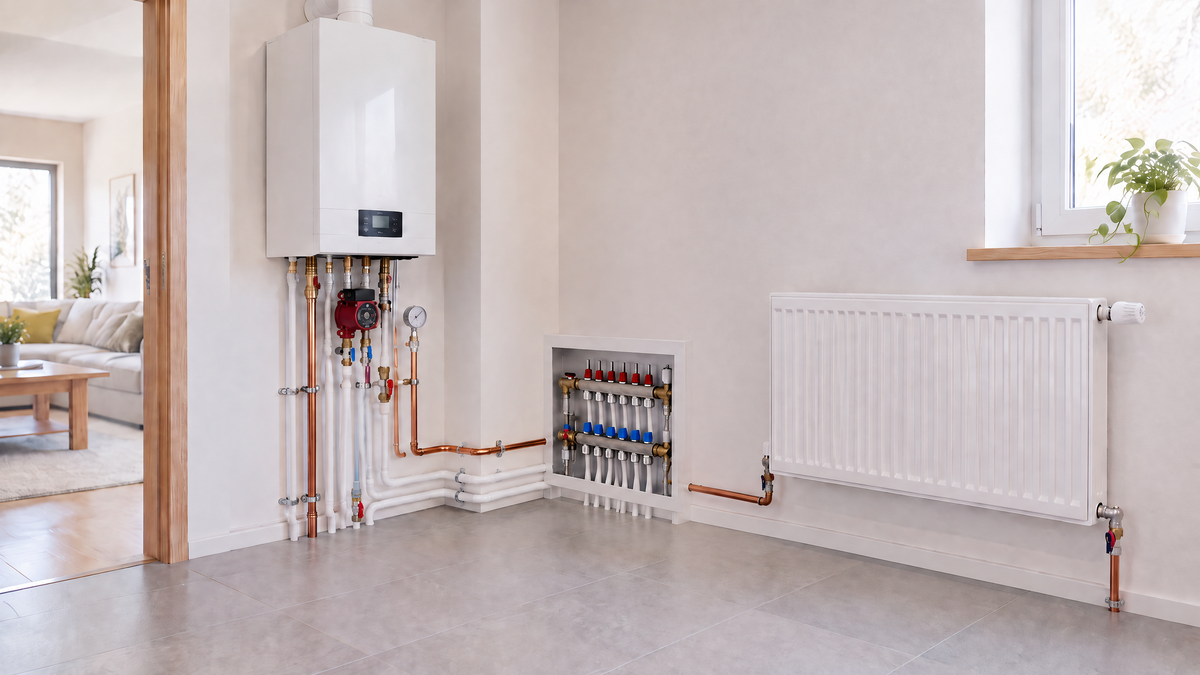
A heating manifold is the control point that distributes warm water through several circuits. It improves balance, service access, and room-by-room control in modern heating layouts.
From the article, you will learn:
- What a heating manifold does in a water-based heating setup
- Where manifolds are used in homes and commercial buildings
- How flow is divided between multiple heating circuits
- Which parts matter most during selection and installation
- How manifolds affect comfort, balance, and maintenance
- The difference between radiator zones and underfloor loops
- What common faults look like and how to prevent them
- When a standard manifold is enough and when a custom layout is better
A clear definition of a heating manifold
A heating manifold is a distribution unit that delivers heated water from a single source to multiple loops. Each loop can serve a different room, floor, or zone, which makes the system easier to regulate and inspect. In simple terms, the answer to what a heating manifold is is this: it is the point where supply and return lines are organized, measured, and controlled. Instead of pushing water through one continuous path, the manifold divides the flow into planned circuits with valves, flow meters, and connection points. This arrangement is common in underfloor heating, multi-zone radiator systems, and mixed layouts that require more precise balance than a single-line network can provide.
How manifold distribution improves control
A manifold improves heating control by separating circuits so each one can be adjusted without disturbing the others. That matters in buildings where rooms lose heat at different rates or where floor finishes and pipe lengths vary. A well-configured central heating manifold system keeps water distribution more stable across the property and makes service work more direct. Installers can isolate a single loop, check a valve, or correct flow on a single branch without interrupting the entire network. For owners, that often means steadier indoor temperatures and fewer guessing steps during maintenance. The manifold also creates a cleaner system layout because major control points are concentrated in one location rather than scattered across many pipe junctions.
Key components inside the manifold set
Most manifolds include a supply bar, a return bar, isolation valves, flow meters, balancing valves, air vents, drain points, and mounting brackets. Some versions also include actuators, thermostatic heads, mixing valves, and pump groups. Each part has a clear job. Flow meters show how much water moves through a loop, while balancing valves limit or increase that loop as needed. Air vents remove trapped air that can reduce circulation. When these parts are selected correctly, the manifold becomes easier to commission and easier to service later.
Where heating manifolds are used most often
The most common use of a heating manifold for hydronic systems is underfloor heating, where each pipe loop must receive the correct share of warm water. Manifolds are also used in radiator zones, low-temperature heating circuits, garage heating, and larger properties with separate occupancy areas. In mixed systems, one manifold can serve floor loops while another handles radiator branches with different temperature requirements. This makes the design more structured and easier to read during installation or repair. Since 2008, ALFA Heating has focused on HVAC and heat-exchange systems, where component compatibility and system-level planning matter just as much as the individual parts. In that context, the manifold is not a minor accessory but a central distribution point.
How water moves through the manifold
The answer to how the heating manifold works starts with supply and return. Heated water leaves the boiler or heat source, enters the supply side of the manifold, and is divided among several circuits. After releasing heat in each zone, the water returns through the return side and flows back to the source for reheating. The manifold makes this cycle easier to control because each circuit can be opened, limited, or isolated individually. When someone asks again what a heating manifold is, the most useful reply is that it is both a distribution hub and a control station. It manages where water goes, how much passes through each loop, and how the system can be serviced without unnecessary disruption.
Flow balancing and zone regulation
Balancing is one of the main reasons manifolds are used. A short loop naturally takes water more easily than a long loop, so without regulation, some rooms heat faster than others. Flow meters and balancing valves solve that by setting a target rate for each circuit. Thermostats can also be linked to actuators on the return rail, so heat is directed only where demand exists. This provides better room-by-room control and reduces uneven heating throughout the building. The result is not just better comfort but also a system that behaves more predictably during daily use.
Choosing the right manifold for a project
The right manifold depends on circuit count, pipe size, target flow rate, control method, and heat source temperature. A heating manifold for a small underfloor zone may require only a few ports and manual balancing, whereas a larger house may require actuators, a mixing set, and pre-mounted accessories. The size of each loop, floor construction, and heat loss of each room should be reviewed before selection. A central heating manifold system must also match the overall layout, including the pump, boiler, heat pump, and any zoning controls. Choosing by price alone can create future problems, such as weak circulation, a narrow balancing range, or limited access to services. A good specification is based on system requirements, not guesswork.
Installation points that affect performance
Manifold location matters. It should be placed where pipe runs are logical, loop lengths stay within design limits, and future service is possible without opening major building finishes. Installers should confirm port count, thread type, valve orientation, mounting height, and access to drain and vent points before fixing the unit in place. Pipe labeling is also worth doing at the start, because it saves time during commissioning and later repairs. Small installation choices directly affect the balance of quality, service speed, and system clarity.
Common problems and how to avoid them
Most manifold-related problems stem from trapped air, improper balancing, poor loop labeling, or incorrect component pairing. A system may show cold areas, noisy circulation, or uneven room temperatures when one loop receives too much water, and another receives too little. These issues do not mean the concept is flawed. They usually point to setup errors or neglected maintenance. In a hydronic heating manifold, regular checks of vents, valves, and flow settings can prevent many service calls. The same applies when reviewing the heating manifold, how it works in an existing property: if the layout is clearly understood, faults are easier to trace. Good commissioning records also make future diagnosis faster and more accurate.
FAQ
A heating manifold distributes warm water from one heat source to several separate circuits. It also gives installers one place to balance flow, isolate loops, vent air, and check return performance during service or commissioning.
No. Underfloor heating is the most common application, but manifolds are also used for radiator zoning, mixed-temperature systems, garages, workshops, and buildings with several areas requiring separate control.
A manifold can separate rooms into different circuits, but temperature differences depend on the wider design. Mixed systems often require additional controls, such as mixing valves, thermostats, or separate distribution groups.
That depends on the manifold model and the hydraulic design. Small units may handle two or three loops, while larger versions can manage many more. The correct number must match flow demand, pipe length, and heat load.
Yes, because valves, vents, and loop connections are grouped in one location. A technician can isolate a branch, inspect the flow, or remove air without disassembling unrelated parts of the heating installation.
Uneven heating usually results from poor balancing, trapped air, blocked valves, incorrect pump settings, or loop lengths not properly considered during design. The manifold often reveals the issue rather than causing it.
It can be recessed in a cabinet, but it should remain accessible. Service access matters for venting, draining, balancing, checking actuators, and identifying each circuit during future repairs or adjustments.
Actuators make sense when the building needs room-by-room temperature regulation. They work with thermostats to open or close specific loops, which is useful in homes or commercial spaces with changing heat demand.