
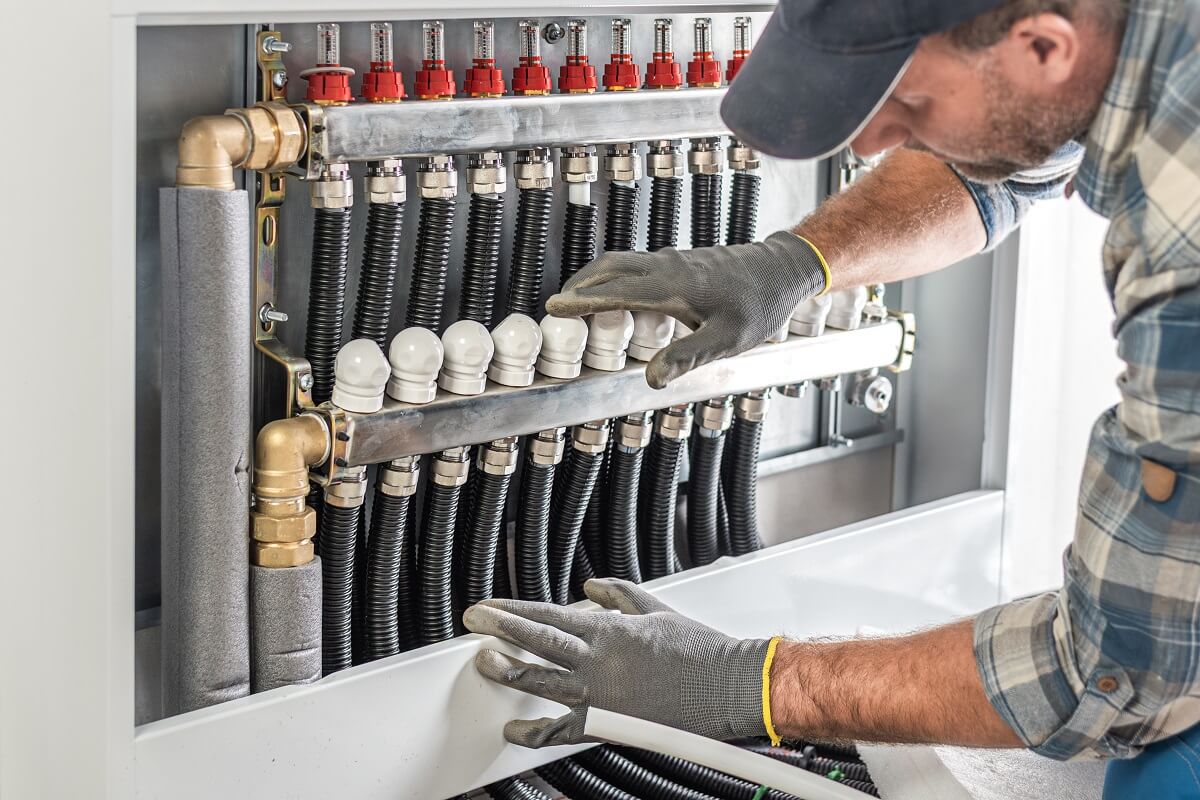
Sizing a circulation pump correctly ensures stable heat delivery, balanced flow, and system safety.
From the article, you will learn:
- What pump sizing means in heating systems
- How flow rate affects heat transfer
- How to calculate the required head pressure
- How pipe layout influences pump selection
- What mistakes lead to poor performance
- How to match pump curves with system demand
- When oversizing or undersizing causes issues
- How to verify calculations in real installations
What circulation pump sizing means in heating systems
Circulation pump sizing establishes the relationship between flow rate and the pressure required to move heated water through a closed-loop system. It determines whether radiators, underfloor loops, or heat exchangers receive the required thermal energy.
The correct size ensures that each terminal unit receives sufficient flow without excessive velocity. If the pump is too small, distant zones remain underheated. If it is too large, noise, erosion, and unnecessary energy consumption appear.
The calculation is based on two measurable values:
- Flow rate (measured in gallons per minute or liters per second)
- Head pressure (measured in feet or meters of water column)
These values depend on system design. Pipe diameter, length, number of fittings, and type of emitters all affect resistance. Each component adds frictional losses that the pump must overcome.
The heating system circulation pump size must match the actual system resistance, not estimated or assumed values. Even small deviations in pipe routing or valve selection can shift the required operating point.
In practice, installers often rely on simplified tables. However, these tables do not account for mixed systems or variable flow conditions. A detailed approach provides more predictable results and reduces post-install adjustments.
How to size a circulation pump step by step
How to size a circulation pump begins with defining the system heat demand. This value is typically expressed in BTU per hour or kilowatts and is derived from heat-loss calculations.
Once heat demand is known, flow rate is calculated using a standard formula:
Flow rate = Heat load ÷ (Temperature difference × Fluid constant)
For water systems, a common temperature difference is 20°F (or 10–15°C depending on design). This value directly affects pump selection. A smaller temperature drop requires a higher flow rate. Next, calculate total head loss:
- Measure total pipe length
- Include the equivalent length of fittings
- Account for valves, filters, and heat exchangers
Each element adds resistance. Manufacturers provide pressure-drop charts that convert flow rate to head loss. Circulation pump sizing is complete when both values are combined and matched with a pump curve. The operating point must fall within the stable region of the pump’s performance chart. Avoid selecting a pump based only on maximum capacity. The correct unit operates near the middle of its curve, where efficiency and stability are balanced.
Understanding flow rate and heat transfer
Flow rate is the amount of heated water that moves through the system per unit time. It directly determines how much energy reaches emitters.
A higher flow rate reduces temperature drop across the system but increases friction losses. A lower flow rate increases the temperature difference but risks uneven heat distribution.
The heating system circulation pump size must reflect this balance. Systems with long loops or multiple branches require careful distribution to avoid uneven heating.
How flow affects system efficiency
Too high flow:
- Increases energy consumption
- Creates noise in pipes and valves
- Accelerates wear
Too low flow:
- Causes cold spots
- Reduces heat output
- Leads to unstable operation
Correct sizing ensures that each circuit receives proportional flow. This is especially important in multi-zone systems where different areas have different heating demands.
Matching flow to emitter type
Radiators, fan coils, and underfloor heating systems require different flow conditions. Underfloor systems operate at lower temperatures and higher flow rates, while radiators require higher temperatures and moderate flow rates.
A proper hydronic pump-sizing guide always links the emitter type to flow requirements. Ignoring this relationship leads to poor thermal comfort and inefficient operation.
Calculating head pressure accurately
Head pressure represents the resistance the pump must overcome to circulate water. It is not related to building height in closed systems but to friction losses.
To calculate head:
- Determine pipe length and diameter
- Include all fittings as equivalent pipe length
- Add pressure drops from components
Each valve, elbow, or heat exchanger contributes to total resistance. Manufacturers provide data tables for precise calculation.
Components that increase head loss
The most common contributors include:
- Control valves
- Balancing valves
- Heat exchangers
- Air separators
- Strainers
Each of these elements must be included in the calculation. Skipping them leads to undersized pumps.
A structured hydronic pump sizing guide helps organize these inputs and prevents omissions. Accurate head calculation ensures the selected pump can maintain flow under all operating conditions.
Choosing the right circulation pump for system stability
Choosing the right circulation pump means aligning calculated flow and head with actual pump performance curves. The selected pump must operate within its efficient range.
Pump curves show how flow rate changes with head pressure. The intersection of the system curve and pump curve defines the operating point.
Modern systems often use variable-speed pumps. These units adjust output based on demand, reducing energy consumption and improving control.
At alfaheating.com, system configurations are verified at the system level to ensure compatibility between pump performance and installation conditions.
Fixed speed vs. variable speed pumps
Fixed-speed pumps:
- Operate at constant output
- Require manual balancing
- May waste energy in low-demand conditions
Variable-speed pumps:
- Adjust to system demand
- Reduce noise and wear
- Improve control in multi-zone systems
Choosing the right circulation pump also involves considering the control strategy, not only hydraulic calculations.
Common mistakes in pump sizing and how to avoid them
Incorrect pump sizing leads to long-term system issues. The most frequent problems result from assumptions rather than calculations.
Oversizing is often seen as a safe choice. In reality, it causes excessive flow, noise, and energy waste. Undersizing leads to insufficient heat delivery and system imbalance.
Frequent sizing errors
- Ignoring pressure drops from fittings
- Using generic tables instead of real data
- Selecting pumps based on pipe size only
- Neglecting system zoning
Another common issue is failing to verify performance after installation. Even correct calculations require confirmation through flow measurement and temperature checks. Properly sizing a circulation pump involves both calculation and validation. A system should be tested under real operating conditions to confirm performance. A correctly sized heating system circulation pump ensures stable operation, balanced heat distribution, and predictable system behavior over time.
FAQ
The most important factor is the relationship between flow rate and head pressure. Both values must match the actual system resistance. Ignoring either parameter leads to incorrect pump selection. Flow ensures heat delivery, while head ensures the pump can overcome system resistance. Accurate data from pipe layouts and components is essential for correct sizing.
Using a larger pump often creates more problems than it solves. Oversized pumps increase velocity, cause noise, and raise energy consumption. They can also damage valves and fittings over time. Proper sizing based on calculations provides better system control and reduces long-term operating issues.
Flow rate is calculated from the heat load and the temperature difference. The formula depends on the unit system, but always links energy demand with fluid movement. For water systems, a standard temperature drop is used to determine the required flow to deliver the required heat output.
If head pressure is underestimated, the pump will not overcome system resistance. This results in poor circulation, uneven heating, and possible system failure in distant zones. Accurate inclusion of all components and fittings is necessary to avoid this issue.
Variable-speed pumps perform well in systems with changing demand, such as multi-zone installations. They adjust output automatically and reduce energy use. However, fixed-speed pumps may still be suitable for simple systems with stable operating conditions.
Verification involves measuring flow rates, checking temperature differences, and confirming that all zones receive adequate heat. Comparing actual performance with design values helps identify any mismatch between calculations and real conditions.



![Brass Barbed Tees 1/2"x1/2"x1/2" Lead Free PEX Crimp"T" Fitting [5pk, 10pk, 25pk]](http://alfaheating.com/cdn/shop/products/brass-barded-tee.jpg?v=1603079042&width=600)
