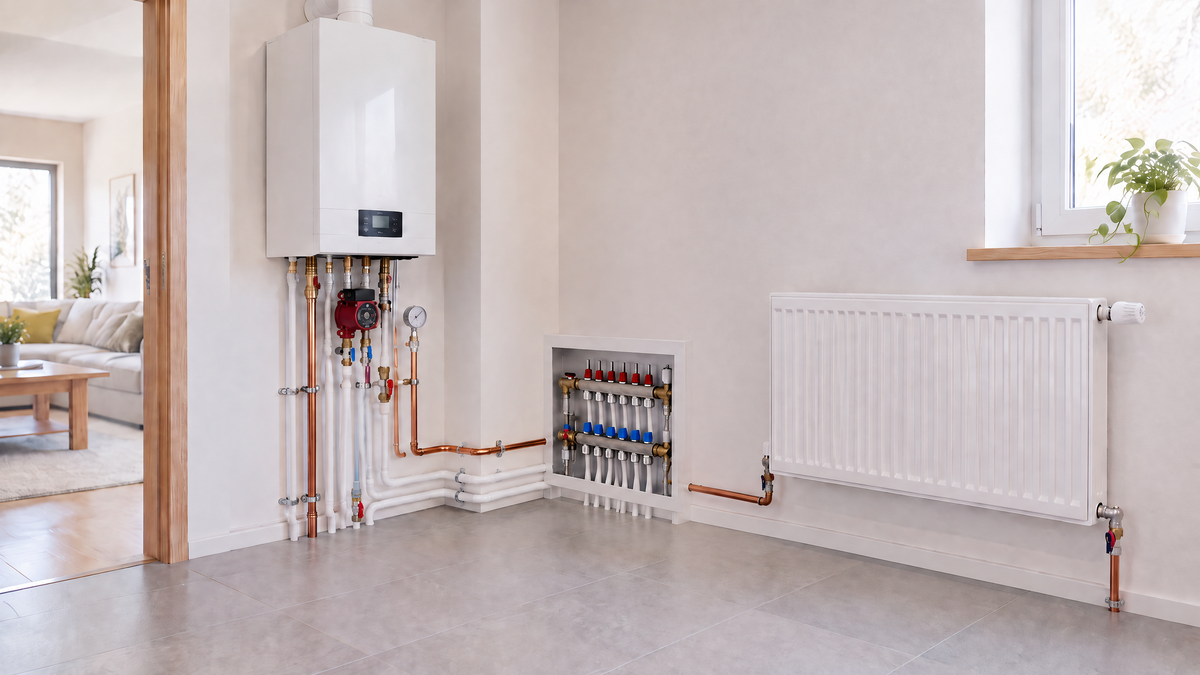
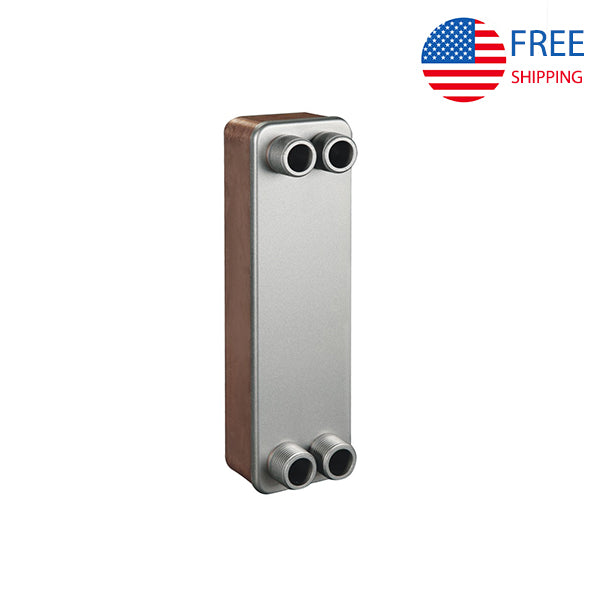
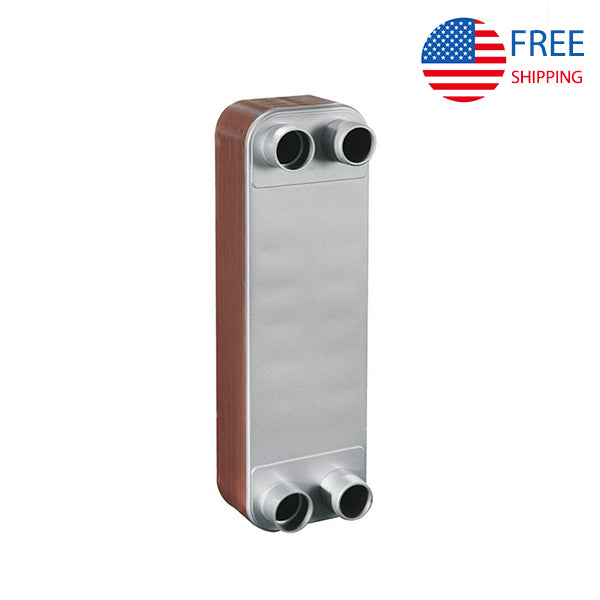
Brazed plate heat exchangers (BPHEs) are widely used in heating systems where heat needs to be transferred efficiently between two separate fluid circuits. Instead of mixing the fluids, a brazed plate heat exchanger transfers heat through thin stainless steel plates while keeping the two circuits separated.
This makes BPHEs a practical solution for applications where a boiler, wood furnace, or other heat source needs to supply heat to a separate heating loop.
In heating systems, common applications include domestic hot water heating, radiant floor heating, snow melting, and industrial or HVAC systems. Wood furnace heating is another application where a BPHE can help separate the heat source loop from the building's heating circuit.
This article explains how brazed plate heat exchangers are used in these four applications and what to consider when integrating a BPHE into a heating system.
How Does a Brazed Plate Heat Exchanger Work in a Heating System?
A brazed plate heat exchanger contains a series of thin stainless steel plates brazed together to form alternating flow channels.
Hot fluid flows through one set of channels while the fluid being heated flows through the adjacent channels. Heat passes through the plates from the hotter fluid to the colder fluid without the two fluids mixing.
In a typical heating application:
Heat Source → BPHE → Heating Load
For example, a boiler may heat water in a primary circuit. The BPHE transfers that heat to a secondary circuit that supplies radiant floor heating or another heating load.
This arrangement allows the two circuits to operate independently while still transferring heat efficiently.
The exact configuration depends on the application, fluid types, temperatures, flow rates, operating pressure, and allowable pressure drop.
1. Domestic Hot Water Heating
One common application for brazed plate heat exchangers is indirect domestic hot water heating.
A heating source such as a boiler can circulate hot water through one side of the BPHE while water on the other side is heated for domestic use.
Typical system configuration
Boiler / Heating Source → BPHE → Domestic Hot Water
The heating water and domestic water remain in separate circuits. Heat is transferred through the stainless steel plates rather than by mixing the two fluids.
This approach can be useful for systems that require rapid heat transfer in a compact package.
Why Use a BPHE for Domestic Hot Water?
A brazed plate heat exchanger can provide:
-
Compact installation compared with many traditional heat exchanger designs
-
Efficient heat transfer between the heating and domestic water circuits
-
Separation between the primary and secondary circuits
-
Low internal fluid volume
-
Flexible installation options
However, applications involving potable or domestic water may require specific materials, certifications, and product approvals. The BPHE should always be selected based on the actual water application and applicable local requirements.
Typical applications
BPHEs may be used for:
-
Boiler-based domestic hot water systems
-
Indirect water heating
-
Hydronic heating systems with separate DHW circuits
-
Commercial hot water systems
-
Heat recovery systems
The required heat exchanger capacity depends on the desired hot water temperature, incoming water temperature, flow rate, and required heating capacity.
2. Floor Heating and Snow Melting
Radiant floor heating and snow melting systems are another practical application for brazed plate heat exchangers.
These systems often use a dedicated heating loop rather than connecting the heat source directly to the distribution circuit.
Radiant Floor Heating
A typical system may look like:
Boiler / Heat Source → BPHE → Floor Heating Loop
The primary side carries heated water from the heat source. The secondary side supplies the radiant floor system.
The BPHE separates the two circuits while transferring heat between them.
This can be useful when the heat source and heating distribution system have different operating requirements.
For example, a boiler may operate at a higher temperature than the water required by a radiant floor system. A separate secondary loop allows the heating distribution system to operate under its own flow and temperature conditions.
Snow Melting Systems
The same principle can be applied to snow melting systems.
A typical configuration is:
Heat Source → BPHE → Snow Melting Loop
The secondary loop circulates heated fluid through tubing installed beneath a driveway, walkway, loading area, or other outdoor surface.
The BPHE transfers heat from the primary heating circuit to the snow melting circuit without requiring the two circuits to be directly connected.
Why Use a BPHE?
A BPHE can be useful when a heating system requires:
-
Separate primary and secondary circuits
-
Different flow rates between the heat source and heating loop
-
Different fluid conditions
-
Compact heat transfer equipment
-
Efficient transfer between heating circuits
For floor heating and snow melting applications, the heat exchanger should be selected based on the required heat load, flow rate, operating temperatures, pressure drop, and fluid characteristics.
3. Industrial and HVAC Heating Systems
Brazed plate heat exchangers are also used in HVAC and industrial systems where heating or cooling must be transferred between separate fluid circuits.
HVAC Applications
In HVAC systems, a BPHE may be used for:
-
Hydronic heating
-
Chilled water systems
-
Heat recovery
-
Equipment cooling
-
Water-to-water heat transfer
-
Separation between primary and secondary circuits
A typical hydronic application may use a boiler or other heat source on the primary side and a building heating loop on the secondary side.
Heat Source → BPHE → Building Heating Loop
The BPHE transfers heat while allowing the two circuits to maintain separate flow conditions.
Industrial Applications
Industrial systems may require heat transfer between process fluids and a heating or cooling medium.
For example:
Process Fluid → BPHE → Heating or Cooling Water
Potential applications include:
-
Process heating
-
Process cooling
-
Equipment cooling
-
Oil cooling
-
Heat recovery
-
Temperature control
The appropriate BPHE configuration depends heavily on the properties of the fluids involved.
Important factors include:
-
Fluid type
-
Fluid viscosity
-
Operating temperature
-
Operating pressure
-
Flow rate
-
Required heat load
-
Allowable pressure drop
-
Material compatibility
For industrial applications, fluid compatibility should be evaluated carefully before selecting the plate and brazing materials.
4. Wood Furnace Heating
Wood furnace and wood boiler systems are another application where a brazed plate heat exchanger can provide useful separation between heating circuits.
A wood furnace may operate as a dedicated heat source while the building uses a separate hydronic heating system.
A typical configuration can be:
Wood Furnace → BPHE → Hydronic Heating System
The primary circuit circulates heated water from the wood furnace. The BPHE transfers heat to a separate secondary circuit serving the building.
The secondary side may supply:
-
Radiant floor heating
-
Baseboard heating
-
Radiators
-
Fan coil units
-
Domestic hot water systems
Why Use a BPHE With a Wood Furnace?
A separate heat exchanger can allow the wood furnace circuit and building heating circuit to operate independently.
This may be beneficial when the two systems have different:
-
Flow requirements
-
Water conditions
-
Operating temperatures
-
Pressure requirements
-
System components
For example, a wood furnace may be connected to one closed or open heating circuit while the building distribution system operates as a separate loop.
The BPHE provides the thermal connection between the two circuits without directly connecting them.
Wood Furnace and Radiant Floor Heating
A particularly useful configuration combines a wood furnace with radiant floor heating:
Wood Furnace → BPHE → Radiant Floor Loop
The wood furnace provides the heat source, while the secondary loop distributes heat through the floor.
This type of system can also be combined with other heat sources or heating zones when the system is designed appropriately.
What Should You Consider When Using a BPHE in a Heating Application?
Although the four applications above are different, several operating conditions are important when integrating a brazed plate heat exchanger into a heating system.
1. Fluid Type
Identify the fluid on each side of the heat exchanger.
Common combinations include:
-
Water-to-water
-
Water-to-glycol
-
Heating water-to-domestic water
-
Water-to-oil
-
Process fluid-to-water
Fluid properties affect heat transfer, pressure drop, and material compatibility.
2. Heat Load
Determine how much heat needs to be transferred.
The required capacity may be expressed in:
-
BTU/hr
-
kW
The heat load should reflect the actual heating requirement of the application rather than simply the size of the connected equipment.
3. Flow Rate
Flow rate affects both heat transfer performance and pressure drop.
Both sides of the heat exchanger should be evaluated.
If the flow rate is too low, the system may not achieve the required heat transfer. If the flow rate is too high, pressure drop may become excessive.
4. Inlet and Outlet Temperatures
The required inlet and outlet temperatures on both sides help determine the thermal duty of the heat exchanger.
For example:
Primary Side:
Hot water entering → cooler water leaving
Secondary Side:
Cool water entering → heated water leaving
The temperature difference and approach temperature are important when evaluating the required heat transfer area.
5. Allowable Pressure Drop
A BPHE should provide the required heat transfer without creating excessive resistance to flow.
The available pump capacity and allowable pressure drop should therefore be considered during system design.
For a deeper explanation of pressure drop and flow rate, see:
Heat Exchanger Pressure Drop: How to Read a Pressure Drop Curve and Choose the Right Flow Rate
6. Operating Pressure and Temperature
Check the actual operating conditions against the heat exchanger's rated pressure and temperature limits.
This is particularly important for systems with high-temperature boilers, industrial process fluids, or variable operating conditions.
7. Material Compatibility
The plate and brazing materials should be compatible with the fluids and operating conditions.
Fluid chemistry, temperature, pressure, and corrosion potential should all be considered when selecting the appropriate construction.
Which Heating Applications Can Benefit From a Brazed Plate Heat Exchanger?
| Application | Typical System Configuration | Main Reason for Using a BPHE |
|---|---|---|
| Domestic hot water | Heating source → BPHE → DHW | Transfer heat between separate circuits |
| Floor heating | Boiler → BPHE → Floor loop | Separate heat source and distribution loops |
| Snow melting | Heat source → BPHE → Snow melting loop | Transfer heat to a dedicated outdoor loop |
| HVAC | Boiler/chiller → BPHE → Building loop | Hydronic heat transfer and system separation |
| Industrial heating/cooling | Process fluid → BPHE → Water | Compact heat transfer between process circuits |
| Wood furnace heating | Wood furnace → BPHE → Heating loop | Separate the heat source and building circuit |
The same BPHE technology can therefore serve very different heating systems. The important point is that the heat exchanger should be matched to the actual application and operating conditions.
When Is a Brazed Plate Heat Exchanger a Good Choice?
A BPHE can be a practical choice when a heating system requires:
-
Efficient heat transfer in a compact footprint
-
Separation between two fluid circuits
-
Water-to-water heat transfer
-
Flexible primary and secondary circuit design
-
Low internal fluid volume
-
A compact alternative for many heating applications
However, BPHEs are not automatically the right solution for every application. Fluid compatibility, pressure, temperature, fouling conditions, flow rate, and allowable pressure drop should be evaluated before selecting a model.
Choosing the Right BPHE for Your Heating System
The best brazed plate heat exchanger depends on the specific application rather than the application name alone.
Before selecting a model, gather the following information:
-
Application — domestic hot water, floor heating, snow melting, HVAC, industrial, wood furnace, etc.
-
Fluid on each side
-
Required heat load
-
Inlet temperature on each side
-
Required outlet temperature
-
Flow rate on each side
-
Allowable pressure drop
-
Operating pressure
-
Operating temperature
-
Required connection size and type
Providing these conditions makes it easier to identify a BPHE that can meet the required thermal performance and operating requirements.
FAQ
Brazed plate heat exchangers are commonly used for domestic hot water heating, radiant floor heating, snow melting, HVAC heating, and wood furnace heating. They transfer heat between separate fluid circuits while keeping the fluids isolated, making them suitable for systems that require hydraulic separation or different fluid conditions.
Yes. A brazed plate heat exchanger for radiant floor heating can separate the boiler or primary heating loop from the floor heating circuit. The same configuration can be used for snow melting systems, allowing the heat source and secondary loop to operate under different flow and pressure conditions.
Yes, a brazed plate heat exchanger can transfer heat from a boiler or other heating source to a domestic hot water circuit. This domestic hot water heat exchanger configuration provides heat transfer between separate circuits. For potable water applications, however, the heat exchanger should have the required materials and certifications for the intended use.
Yes. A brazed plate heat exchanger for wood furnace heating can separate the wood furnace loop from a hydronic heating system. The secondary side can supply radiant floor heating, baseboard radiators, fan coils, or other hydronic heating equipment while keeping the two circuits separate.
To choose the right brazed plate heat exchanger for a heating system, consider the required heat load, flow rate, inlet and outlet temperatures, allowable pressure drop, operating pressure, operating temperature, fluid type, and connection size. These conditions determine the appropriate heat transfer capacity and heat exchanger configuration for the application.