Pressure drop is one of the most important factors to consider when selecting and sizing a heat exchanger. A heat exchanger may have enough heat transfer capacity for an application, but if the pressure drop is too high, the system may require a larger pump, consume more energy, or fail to achieve the required flow rate.
Understanding how to read a heat exchanger pressure drop curve makes it easier to determine whether a particular model is suitable for your system. Pressure drop data is specific to the heat exchanger model, fluid, flow rate, and operating conditions.
The examples in this guide are for general illustration and should not be considered performance data for a specific heat exchanger unless otherwise stated.
In this guide, we explain what heat exchanger pressure drop means, how to read a pressure drop curve, how flow rate affects pressure loss, and how to choose an appropriate operating flow rate.
What Is Pressure Drop in a Heat Exchanger?
Heat exchanger pressure drop is the difference in pressure between the inlet and outlet of a heat exchanger.
When fluid flows through the heat exchanger, it passes through channels, plates, tubes, ports, bends, and other internal passages. Friction and changes in flow direction create resistance to the fluid flow. This resistance results in a pressure loss.
Pressure drop is commonly expressed in:
-
PSI in the United States
-
kPa or bar in metric systems
-
feet of head for some pump and hydronic applications
For a heat exchanger with an inlet pressure of 30 PSI and an outlet pressure of 25 PSI, the pressure drop is:
Pressure Drop = Inlet Pressure − Outlet Pressure
30 PSI − 25 PSI = 5 PSI
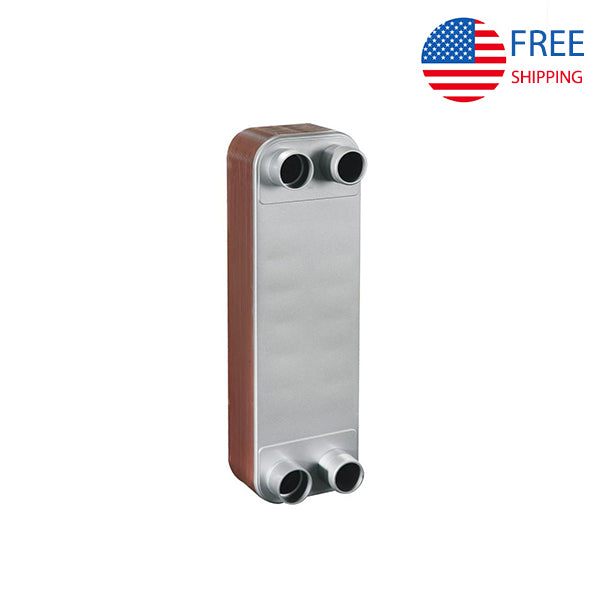
The pressure drop should normally be evaluated separately for each fluid circuit. For example, a brazed plate heat exchanger may have one pressure drop on the hot-water side and another on the cold-water side.
Pressure drop is not necessarily a problem. Some pressure loss is expected because fluid must move through the heat exchanger. The goal is to find a balance between heat transfer performance, required flow rate, pumping capacity, and energy consumption.
How to Read a Heat Exchanger Pressure Drop Curve
A pressure drop curve shows how pressure loss changes as the fluid flow rate increases. Because pressure drop depends on heat exchanger design and operating conditions, pressure drop curves are specific to individual models and fluid circuits.
A typical curve has:
-
Flow rate on the horizontal axis
-
Pressure drop on the vertical axis
The exact units depend on the manufacturer's data. Flow rate may be shown in GPM, L/min, or m³/h, while pressure drop may be shown in PSI, kPa, or feet of head.
To use the curve, first determine the required operating flow rate.
For example, suppose your system requires 20 GPM.
-
Locate 20 GPM on the horizontal axis.
-
Move vertically until you reach the pressure drop curve.
-
From the intersection point, move horizontally toward the pressure-drop axis.
-
Read the approximate pressure drop.
If an example curve indicates approximately 4 PSI at 20 GPM, the heat exchanger would have about 4 PSI of pressure loss at that flow rate under the conditions represented by the curve. Actual pressure drop should be determined from the applicable manufacturer's data for the specific heat exchanger model and operating conditions.
Why the Curve Is Usually Not a Straight Line
Pressure drop generally increases faster than flow rate.
As flow increases, fluid velocity through the heat exchanger also increases. Higher velocity creates greater friction and turbulence, causing pressure drop to rise rapidly.
This means that increasing flow from 10 GPM to 20 GPM does not necessarily double the pressure drop.
In many flow systems, pressure drop increases approximately with the square of flow rate under comparable conditions. This means that a relatively small increase in flow rate can result in a significant increase in pressure drop.
However, the actual relationship depends on the heat exchanger design, fluid properties, flow regime, channel geometry, and operating conditions. The relationship should not be used to estimate the pressure drop of a specific heat exchanger unless the applicable performance data is available. Always use the manufacturer's pressure drop data whenever it is available.
How Flow Rate Affects Heat Exchanger Pressure Drop
Flow rate is one of the most important variables affecting pressure drop.
At a low flow rate, fluid moves relatively slowly through the heat exchanger. The resulting pressure loss is generally low, but the heat transfer coefficient may also be lower.
As flow rate increases, fluid velocity increases. This can improve turbulence and heat transfer performance, but it also increases pressure drop.
This creates an important design trade-off:
Higher flow rate → potentially better heat transfer → higher pressure drop
Lower flow rate → lower pressure drop → potentially lower heat transfer performance
For example, consider a hypothetical heat exchanger with the following pressure drop data:
| Flow Rate | Approx. Pressure Drop |
|---|---|
| 10 GPM | 1.0 PSI |
| 15 GPM | 2.0 PSI |
| 20 GPM | 3.5 PSI |
| 25 GPM | 5.5 PSI |
| 30 GPM | 8.0 PSI |
The values above are hypothetical examples for explaining the relationship between flow rate and pressure drop. They are not performance data for a specific Alfa Heating heat exchanger.
The pressure drop does not increase linearly with flow rate.
This is why simply choosing the highest possible flow rate is usually not the best approach.
The correct flow rate should provide sufficient heat transfer while remaining within the pressure-drop limit of the system.
What Is an Acceptable Pressure Drop?
There is no single pressure-drop value that is appropriate for every heat exchanger application.
An acceptable pressure drop depends on the system design, available pump head, required flow rate, fluid type, operating temperature, and energy-efficiency requirements.
For example, a hydronic heating system may have a different pressure-drop requirement from an industrial process system or swimming pool heating system.
When selecting a heat exchanger, consider the following questions:
1. How much pump head is available?
The pump must be capable of overcoming the pressure loss through the entire system, including:
-
Heat exchanger
-
Piping
-
Valves
-
Filters
-
Elbows and fittings
-
Other system components
If the heat exchanger consumes too much of the available pump head, the system may not achieve the required flow rate.
2. What flow rate is required?
The heat exchanger must provide the required thermal capacity at the actual operating flow rate.
A model should not be selected based only on its maximum BTU/hr rating.
3. How important is energy efficiency?
Higher pressure drop means the pump generally needs to work harder. In systems operating continuously, excessive pressure drop can increase pumping energy and operating costs.
4. Is the pressure drop balanced between the two circuits?
For some applications, the pressure drop on the hot side and cold side should be considered separately.
A heat exchanger with acceptable pressure drop on one side may still create excessive resistance on the other side.
How to Choose the Right Flow Rate
Choosing the correct flow rate requires more than simply looking for the lowest pressure drop.
A good starting point is to determine the required heat load and temperature change.
For water systems, heat transfer can be estimated using:
BTU/hr = 500 × GPM × ΔT
Where:
-
BTU/hr = required heating or cooling capacity
-
GPM = water flow rate
-
ΔT = temperature difference in °F
-
500 = approximate water heat capacity factor under typical conditions
For example, if a system needs to transfer 500,000 BTU/hr with a 20°F temperature difference:
GPM = 500,000 ÷ (500 × 20)
GPM = 50
The required water flow rate would therefore be approximately 50 GPM.
Once the required flow rate has been calculated, use the applicable manufacturer's performance data or pressure drop curve for the specific heat exchanger model to check the expected pressure loss at 50 GPM.
If the pressure drop is higher than the available pump capacity, consider:
-
Selecting a larger heat exchanger
-
Choosing a model with larger flow passages
-
Using a different heat exchanger configuration
-
Reducing unnecessary flow restrictions
-
Reviewing the system's pump selection
The goal is not simply to minimize pressure drop. The goal is to achieve the required heat transfer capacity at a flow rate that the system can support efficiently.
Pressure Drop Differences Between Heat Exchanger Types
Different heat exchanger designs can have significantly different pressure-drop characteristics.
Brazed Plate Heat Exchangers
Brazed plate heat exchangers typically use narrow channels between corrugated plates. The corrugation creates turbulence and increases heat transfer efficiency.
However, the same design features that improve heat transfer can also create higher pressure drop.
For this reason, pressure drop should always be checked when selecting a brazed plate heat exchanger.
Shell and Tube Heat Exchangers
Shell and tube heat exchangers have different pressure-drop characteristics because fluid flows through tubes and/or around tube bundles inside a shell.
Pressure drop depends on factors such as:
-
Tube diameter
-
Tube length
-
Number of tube passes
-
Shell-side flow arrangement
-
Baffle configuration
-
Fluid velocity
A shell and tube heat exchanger may therefore have very different pressure-drop behavior from a similarly rated plate heat exchanger.
Air-to-Water Heat Exchangers
Air-to-water heat exchangers have pressure-drop considerations on both the water side and air side.
For the water circuit, flow rate and internal tube geometry affect pressure loss. On the air side, coil design, fin density, airflow, and face velocity influence air pressure drop.
Therefore, both sides should be evaluated during system design.
What Causes Excessive Pressure Drop?
If the measured pressure drop is significantly higher than expected, several factors may be responsible.
Excessive Flow Rate
The most common reason is simply that the actual flow rate is higher than the design flow rate.
Because pressure drop increases rapidly with flow, even a moderate increase in flow can significantly increase pressure loss.
Fouling or Blockage
Dirt, scale, biological growth, or debris can restrict internal flow passages.
This is particularly important in systems using untreated water, pool water, process fluids, or fluids containing suspended particles.
A partially blocked heat exchanger can show a higher pressure drop while delivering reduced heat transfer performance.
Incorrect Pump Selection
An oversized pump may force more fluid through the heat exchanger than necessary.
The result can be excessive pressure drop, higher energy consumption, and potentially unnecessary wear on system components.
Fluid Properties
Pressure drop depends not only on flow rate but also on fluid properties.
Viscosity is particularly important. A fluid with higher viscosity generally produces greater resistance to flow.
This means a pressure drop curve developed using water should not automatically be applied to oil, glycol mixtures, refrigerants, or other fluids without considering their properties.
Incorrect Heat Exchanger Selection
A heat exchanger that is too small for the required flow rate may have sufficient theoretical thermal capacity under certain conditions but still create excessive pressure loss.
When pressure drop is a major system constraint, selecting a larger heat exchanger can sometimes reduce pressure loss while maintaining the required thermal performance.
How to Use a Pressure Drop Curve When Selecting a Heat Exchanger
A practical heat exchanger selection process can follow these steps:
Step 1: Determine the required heat load
Calculate the required BTU/hr or kW capacity.
Step 2: Determine the required inlet and outlet temperatures
Establish the expected supply and return temperatures for both circuits.
Step 3: Calculate the required flow rate
Use the heat load and temperature difference to estimate the required flow.
Step 4: Check the manufacturer's available performance data
Confirm that the heat exchanger can achieve the required capacity at the actual operating conditions.
Step 5: Check the pressure drop data, if available
If a pressure drop curve or other applicable pressure-loss data is available for the specific model, find the operating flow rate and determine the corresponding pressure drop.
Step 6: Compare pressure drop with available pump capacity
Make sure the heat exchanger does not consume an excessive portion of the available pump head.
Step 7: Check both sides of the heat exchanger
Evaluate pressure drop independently for the hot and cold circuits.
Step 8: Consider real operating conditions
Account for fluid viscosity, glycol concentration, fouling potential, water quality, and possible changes in flow rate.
A properly selected heat exchanger should provide the required heat transfer performance without creating unnecessary resistance in the system.
Final Takeaway
Understanding a heat exchanger pressure drop curve is essential for selecting the right model and operating flow rate.
The key relationship to remember is:
Higher flow rate generally means higher pressure drop.
However, lower pressure drop is not always better. A flow rate that is too low may reduce heat transfer performance, while an unnecessarily high flow rate can increase pump energy consumption and system resistance.
The best selection balances:
-
Required heat transfer capacity
-
Flow rate
-
Temperature difference
-
Pressure drop
-
Pump capacity
-
Fluid properties
-
Long-term operating conditions
If you are selecting a brazed plate heat exchanger, shell and tube heat exchanger, or another type of heat exchanger and are unsure whether the pressure drop is acceptable, compare your required flow rate with the available manufacturer's pressure drop or pressure-loss data for the specific model before making a final selection.