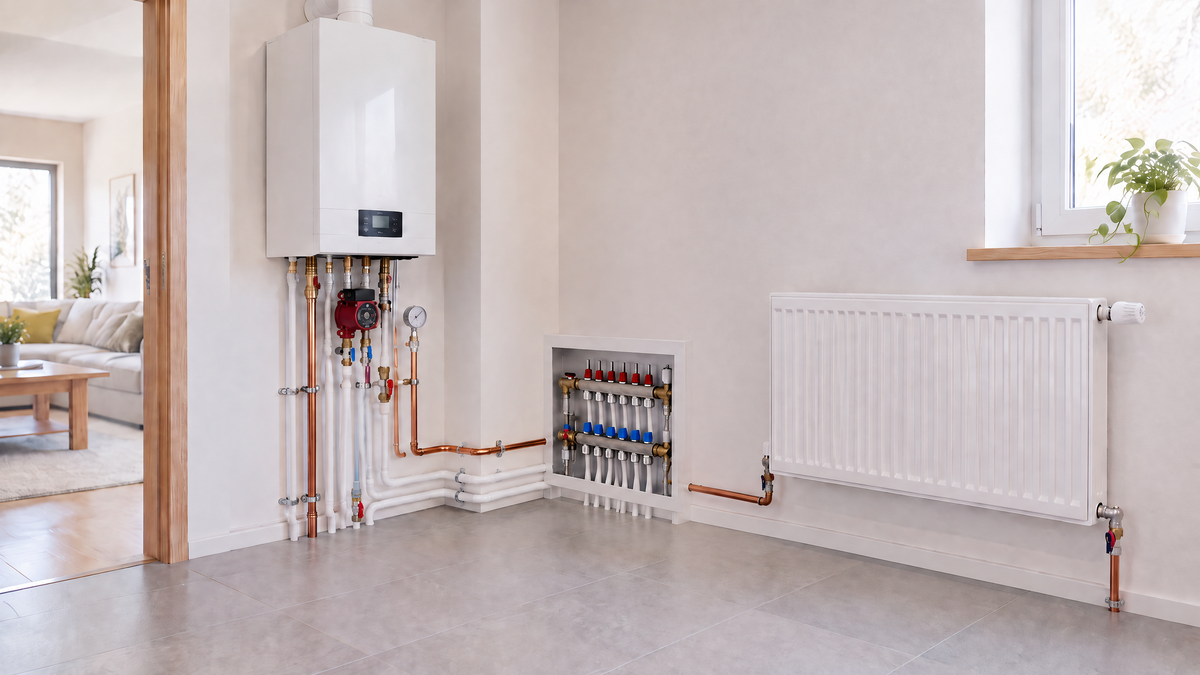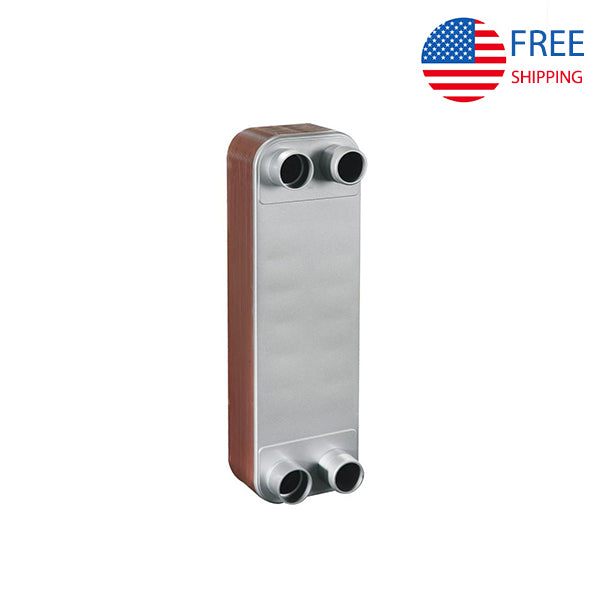
Plate heat exchangers are widely used in modern HVAC systems for heating, cooling, heat transfer, hydraulic separation, domestic hot water production, and heat recovery. Their compact design and large heat transfer surface make them a practical solution for residential, commercial, and industrial HVAC applications.
However, selecting an HVAC plate heat exchanger is not simply a matter of matching the heat exchanger's BTU rating to the system capacity. Flow rate, inlet and outlet temperatures, fluid type, pressure drop, operating pressure, connection size, and the required temperature approach all affect the appropriate heat exchanger configuration.
This guide explains how plate heat exchangers are used in HVAC systems, which applications they are best suited for, and what information you need when selecting a unit.
What Is an HVAC Plate Heat Exchanger?
An HVAC plate heat exchanger is a heat transfer device used to transfer thermal energy between two separate fluid circuits without mixing the fluids.
Inside the heat exchanger, thin corrugated plates create alternating channels for the two fluids. Heat passes through the metal plates from the hotter fluid to the colder fluid while the two circuits remain separated.
For example, in a hydronic heating system, hot boiler water can transfer heat through a plate heat exchanger to a separate building heating loop.
Boiler → Plate Heat Exchanger → HVAC Heating Loop
The same principle can be used for cooling:
Chiller → Plate Heat Exchanger → Secondary Cooling Loop
This separation can be useful when the primary and secondary circuits have different pressures, fluid conditions, flow requirements, or water quality.
Brazed plate heat exchangers are commonly used in HVAC and hydronic applications because their compact construction provides a large heat transfer surface in a relatively small footprint. They are used across heating, cooling, heat pump, domestic hot water, and other fluid-to-fluid applications.
Why Are Plate Heat Exchangers Used in HVAC Systems?
Compared with larger traditional heat exchanger designs, plate heat exchangers can provide several advantages for HVAC applications.
Compact Size
The corrugated plate design creates a large effective heat transfer area within a relatively small package. This is particularly useful in mechanical rooms and other installations where space is limited.
Efficient Heat Transfer
The narrow channels and corrugated plate surfaces promote turbulent flow, which can improve heat transfer performance.
Separation of Fluid Circuits
A plate heat exchanger can separate two hydronic circuits while transferring heat between them. This can be useful for boiler isolation, pressure separation, different water loops, and other HVAC configurations.
Flexible Applications
Plate heat exchangers can be used for both heating and cooling applications, including boilers, heat pumps, chilled-water systems, radiant heating, domestic hot water, and heat recovery.
Multiple Configuration Options
Depending on the application, engineers can select different plate counts, plate sizes, connection sizes, materials, flow configurations, and pressure ratings.
Common HVAC Applications for Plate Heat Exchangers
A plate heat exchanger can be used in many different HVAC system configurations. The correct application depends on the required heat transfer duty and operating conditions.
1. Boiler-to-Hydronic Heating Systems
One of the most common applications is transferring heat from a boiler circuit to a separate hydronic heating circuit.
For example:
Boiler → Primary Loop → Plate Heat Exchanger → Secondary Heating Loop
The secondary loop may supply:
- Radiators
- Fan coil units
- Air handling units
- Radiant floor heating
- Baseboard heating
- Other hydronic heating equipment
The heat exchanger allows the two water circuits to remain separate while transferring heat between them.
This configuration can be especially useful when the primary and secondary circuits operate at different pressures or require hydraulic separation.
2. Radiant Floor Heating
Plate heat exchangers can be used to transfer heat from a boiler or other high-temperature source to a radiant floor heating loop.
For example, the primary side may contain higher-temperature boiler water while the secondary side supplies a lower-temperature radiant floor circuit.
The actual heat exchanger size should be selected based on the required heating capacity, flow rates, supply and return temperatures, and allowable pressure drop rather than simply the floor area.
3. Heat Pump Systems
Heat pumps are another important application for plate heat exchangers.
Depending on the system design, a plate heat exchanger may be used to transfer heat between:
- Heat pump and hydronic heating loop
- Heat pump and chilled-water loop
- Heat pump and domestic hot water system
- Ground-source or water-source loop and building loop
Heat pump applications can have different flow rates and temperature requirements from conventional boiler systems, so the heat exchanger should be selected using the actual operating conditions.
Plate heat exchangers are widely used in heat pump heating and cooling applications.
4. Chilled Water and Cooling Systems
Plate heat exchangers can also be used in HVAC cooling systems.
A typical configuration is:
Chiller → Primary Chilled Water Loop → Plate Heat Exchanger → Secondary Cooling Loop
Applications may include:
- Commercial building cooling
- Chilled-water systems
- Cooling loop separation
- Chiller bypass systems
- Process cooling connected to HVAC systems
The heat exchanger must be selected according to the required cooling capacity, flow rate, entering and leaving temperatures, fluid type, and allowable pressure drop.
5. Domestic Hot Water Systems
Plate heat exchangers are also commonly used to produce domestic hot water.
A typical indirect DHW system may use hot water from a boiler or heat pump on the primary side to heat incoming potable water on the secondary side.
Heating Source → Plate Heat Exchanger → Domestic Hot Water
This arrangement can provide hot water without requiring the primary heating water and potable water to mix.
For potable-water applications, material compatibility and applicable local codes and regulations should always be considered.
6. District Heating and Building Heat Transfer
In larger commercial or multi-building systems, plate heat exchangers can separate a primary heating network from a building's secondary HVAC system.
The primary network may operate at different pressures and temperatures from the building loop.
The plate heat exchanger provides thermal transfer while keeping the two circuits hydraulically separate.
Plate heat exchangers are widely used in district heating, building heating, and commercial HVAC applications.
7. Geothermal and Water-Source HVAC Systems
In geothermal and water-source systems, the source-side fluid may have different water quality or operating conditions from the building's HVAC loop.
A plate heat exchanger can provide a thermal barrier between the source loop and the building loop.
This can help isolate the building-side equipment from the source-side fluid while still allowing heat transfer.
Brazed Plate vs. Gasketed Plate Heat Exchanger for HVAC
Not every HVAC application requires the same type of plate heat exchanger.
Two common configurations are brazed plate heat exchangers and gasketed plate-and-frame heat exchangers.
| Feature | Brazed Plate Heat Exchanger | Gasketed Plate Heat Exchanger |
|---|---|---|
| Construction | Permanently brazed | Gasketed plate pack |
| Size | Compact | Larger |
| Maintenance | Low routine maintenance | Plates can be opened for cleaning |
| Capacity | Small to medium applications, depending on model | Broad range, including large systems |
| Footprint | Small | Larger |
| Customization | Configuration dependent | Highly configurable |
| Typical HVAC Uses | Heating, cooling, heat pumps, DHW | Commercial HVAC, district energy, larger systems |
For compact HVAC installations, brazed plate heat exchangers can be particularly attractive because they combine a small footprint with high heat transfer performance.
For larger systems where frequent inspection or mechanical cleaning is important, a gasketed plate-and-frame heat exchanger may be more appropriate.
The best choice depends on the application, fluid quality, capacity, pressure, temperature, maintenance requirements, and installation conditions.
How to Size a Plate Heat Exchanger for HVAC
Correct sizing is one of the most important parts of selecting an HVAC plate heat exchanger.
A heat exchanger that is too small may not provide the required heating or cooling capacity. A unit that is significantly oversized may increase equipment cost and may not operate at the desired flow and pressure-drop conditions.
The main parameters used for HVAC heat exchanger selection include:
- Heating or cooling capacity
- Primary-side flow rate
- Secondary-side flow rate
- Primary-side inlet temperature
- Primary-side outlet temperature
- Secondary-side inlet temperature
- Secondary-side outlet temperature
- Fluid type
- Operating pressure
- Allowable pressure drop
- Connection size
The heat exchanger's actual performance depends on the combination of these operating conditions rather than one specification alone.
1. Determine the Required Heating or Cooling Capacity
First determine how much heat needs to be transferred.
HVAC systems may specify capacity in:
- BTU/hr
- MBH
- kW
For example:
500,000 BTU/hr = 500 MBH
However, the required heat exchanger capacity should be based on the actual system duty rather than simply selecting a heat exchanger with the same nominal number printed on the product label.
2. Determine the Flow Rate on Both Sides
Flow rate is one of the most important factors in heat exchanger selection.
You may need:
Primary-side flow rate
and
Secondary-side flow rate
For water systems, flow rate is commonly expressed in GPM.
For example:
- Primary side: 40 GPM
- Secondary side: 60 GPM
The two flow rates do not necessarily have to be identical.
The required flow depends on the desired temperature change, heat load, fluid properties, and system design.
3. Determine the Inlet and Outlet Temperatures
The four temperatures are also important:
- Hot-side inlet
- Hot-side outlet
- Cold-side inlet
- Cold-side outlet
For example:
Hot side: 180°F → 160°F
Cold side: 120°F → 140°F
These temperatures help determine the available temperature driving force for heat transfer.
4. Consider the Temperature Approach
The temperature approach is the difference between the relevant hot-side and cold-side temperatures at the heat exchanger outlet.
A smaller approach can allow a system to achieve closer temperature matching, but it can also require more heat transfer area.
This is one reason why two systems with the same BTU/hr requirement may require different heat exchanger configurations.
Close-temperature applications are one area where plate heat exchangers can be particularly useful.
Why Pressure Drop Matters in HVAC Heat Exchanger Selection
Heat transfer capacity is not the only consideration.
Every heat exchanger creates some pressure drop as fluid passes through its internal channels.
If the pressure drop is too high for the system, the pump may not be able to provide the required flow.
Therefore, the goal is not simply:
"Choose the heat exchanger with the highest BTU rating."
Instead, the selected unit should provide the required heat transfer while maintaining an acceptable pressure drop at the actual design flow rate.
When comparing heat exchanger models, check the pressure-drop performance at your actual flow rate rather than relying only on the nominal product capacity.
Flow rate, fluid properties, channel design, and heat exchanger configuration all affect pressure drop.
What Fluid Is Being Used?
Fluid type is another important selection factor.
Common HVAC fluids include:
- Water
- Water/glycol mixtures
- Heating water
- Chilled water
- Potable water
- Refrigerants in specialized refrigeration or heat pump applications
Glycol concentration can affect viscosity, heat transfer performance, and pressure drop.
Therefore, if your system uses glycol rather than water, the glycol concentration should be included when requesting heat exchanger sizing.
For refrigerant applications, the heat exchanger must be specifically selected for the refrigerant, operating pressure, phase-change duty, and required thermal performance.
How to Choose the Plate Heat Exchanger Material
Material selection should be based on the fluid, temperature, pressure, water chemistry, and application.
Common plate materials include stainless steel grades such as 304 and 316/316L, while brazing materials may include copper or other specialized options depending on the heat exchanger design.
For many standard hydronic HVAC applications using clean water, stainless steel plates with copper brazing are commonly used.
For more demanding fluids or water chemistry, the appropriate material and construction should be evaluated carefully.
For example, applications involving high chloride levels, saltwater, or aggressive fluids may require materials specifically selected for corrosion resistance.
Do not choose the heat exchanger material based only on price. Compatibility with the actual fluid is essential for long-term reliability.
How to Choose the Right Connection Size
The connection size should be compatible with the system piping and required flow rate.
Common connection sizes may include:
- 3/4"
- 1"
- 1-1/4"
- 1-1/2"
- 2"
- Larger flanged connections for high-flow systems
However, a larger connection does not automatically mean a higher heat transfer capacity.
Connection size, internal channel configuration, flow rate, pressure drop, and heat transfer area all work together.
Before ordering a heat exchanger, verify:
- Connection type
- Connection size
- Connection orientation
- Pipe size
- Flow direction
- Available installation space
This can help prevent compatibility problems during installation.
Common Mistakes When Selecting an HVAC Plate Heat Exchanger
Mistake 1: Selecting Only by BTU Rating
Two systems with the same BTU/hr requirement can require different heat exchanger configurations because their temperatures and flow rates may be different.
Mistake 2: Ignoring Flow Rate
A heat exchanger needs appropriate fluid flow to achieve the intended thermal performance.
Always provide the flow rate for both sides when possible.
Mistake 3: Ignoring Pressure Drop
A heat exchanger that meets the required capacity but creates excessive pressure drop may not work properly with the existing pump.
Mistake 4: Using Water Data for a Glycol System
Glycol changes fluid properties and can affect heat exchanger performance.
If your system uses glycol, include the concentration when requesting a selection.
Mistake 5: Choosing Based Only on Pipe Size
A 1-inch pipe does not automatically mean that every 1-inch connection heat exchanger will have the same performance.
Connection size should be evaluated together with flow rate, pressure drop, and heat transfer requirements.
Mistake 6: Ignoring Fluid Compatibility
The plate and brazing materials need to be compatible with the actual fluid and operating conditions.
Mistake 7: Providing Only the Equipment Size
For example, saying:
"I have a 500,000 BTU boiler. Which heat exchanger do I need?"
may not provide enough information for accurate selection.
The boiler capacity is useful, but the heat exchanger should ideally be selected using the actual operating temperatures and flow rates.
HVAC Plate Heat Exchanger Selection Checklist
Before selecting or requesting a quotation, collect the following information:
| Parameter | Example |
|---|---|
| Application | Hydronic heating |
| Required capacity | 500,000 BTU/hr |
| Hot-side inlet temperature | 180°F |
| Hot-side outlet temperature | 160°F |
| Cold-side inlet temperature | 120°F |
| Cold-side outlet temperature | 140°F |
| Hot-side flow rate | 50 GPM |
| Cold-side flow rate | 60 GPM |
| Fluid | Water |
| Glycol concentration | 0% |
| Operating pressure | 150 PSI |
| Maximum allowable pressure drop | Application dependent |
| Connection size | 1-1/2" |
| Connection type | NPT / sweat / flange |
| Material requirement | 316L stainless steel |
The more complete the operating information, the more accurately the appropriate heat exchanger can be selected.
A brazed plate heat exchanger can be a strong choice when the HVAC system requires:
- Compact equipment
- Efficient fluid-to-fluid heat transfer
- Separate primary and secondary circuits
- Low installation footprint
- Heating or cooling between compatible fluids
- Low routine maintenance
Typical applications include:
- Boiler heating
- Hydronic heating
- Heat pumps
- Chilled water
- Domestic hot water
- Radiant heating
- Geothermal systems
- Commercial HVAC
Brazed plate heat exchangers are used across heating, cooling, heat pump, air-conditioning, refrigeration, and domestic hot water applications.
For systems requiring frequent internal inspection or mechanical cleaning, however, a gasketed plate-and-frame design may be more appropriate.
FAQ
An HVAC plate heat exchanger is a compact heat transfer device used in heating, cooling, heat pump, and hydronic HVAC systems. It transfers heat between two separate fluid circuits without directly mixing the fluids. A plate heat exchanger for HVAC can be used for boiler heating, chilled water, radiant floor heating, domestic hot water, heat pump systems, and other fluid-to-fluid heat transfer applications.
Yes. A brazed plate heat exchanger can be used for a wide range of HVAC applications, including hydronic heating, boiler-to-water heating, chilled water cooling, radiant floor heating, and heat pump systems. The appropriate plate heat exchanger for heating or cooling should be selected based on the required capacity, flow rate, inlet and outlet temperatures, fluid type, pressure drop, and operating pressure.
Plate heat exchanger sizing requires more than matching the heat exchanger's BTU/hr rating to the boiler, chiller, or heat pump capacity. You should consider the required heating or cooling capacity, flow rate on both sides, inlet and outlet temperatures, temperature approach, fluid type, allowable pressure drop, operating pressure, and connection size. For systems using glycol or other fluids, fluid concentration and properties should also be considered when selecting an HVAC plate heat exchanger.
There is no single standard plate heat exchanger flow rate for every HVAC system. The required flow depends on the heat load, temperature difference, fluid properties, heat exchanger configuration, and allowable pressure drop. Both the primary-side and secondary-side flow rates should be evaluated when selecting a plate heat exchanger for HVAC, particularly for boiler, hydronic heating, chilled water, and heat pump heat exchanger applications.
To choose the right HVAC plate heat exchanger, provide the application, required heating or cooling capacity, fluid on both sides, inlet and outlet temperatures, primary and secondary flow rates, operating pressure, allowable pressure drop, connection size, and material requirements. For a brazed plate heat exchanger, the number and size of plates, connection configuration, and material compatibility should also be considered. If you are comparing plate heat exchanger price or cost, make sure you compare units based on comparable capacity and operating conditions rather than price alone.