
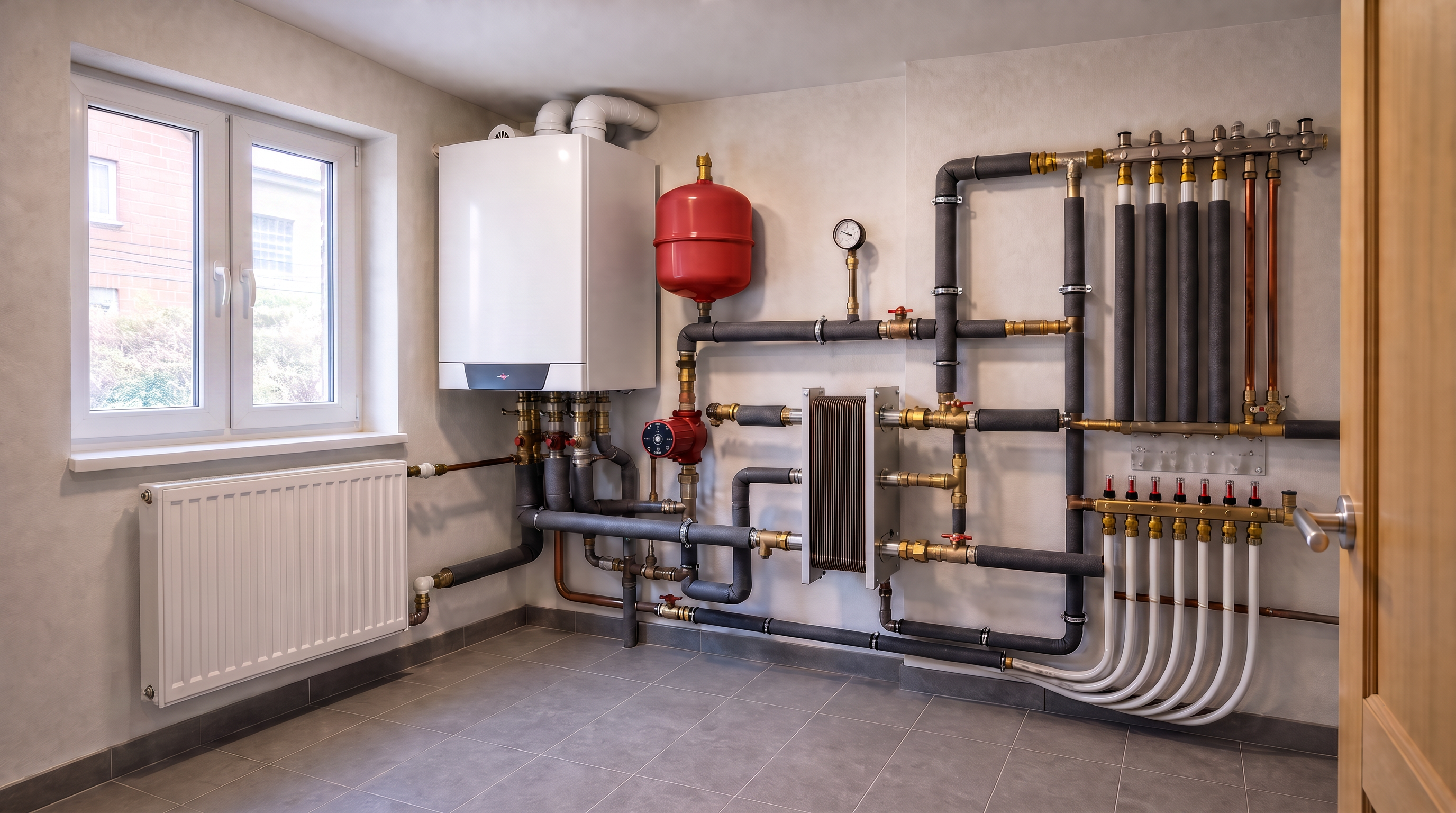
Hydronic heating systems use heated water or a water-based fluid to transfer heat throughout a building. They are commonly used in radiant floor heating, radiators, fan coil units, air handlers, and other heating applications.
In many hydronic systems, a heat exchanger is used to transfer heat between two separate fluid circuits. This allows the heat source and the heating distribution system to operate independently while maintaining efficient heat transfer between them.
Understanding how these components work together can help system designers and installers determine when a heat exchanger is appropriate and what factors should be considered during system design.
What Is a Hydronic Heating System?
A hydronic heating system circulates heated water through pipes to deliver heat to different areas of a building.
A basic system typically includes:
- A boiler or another heat source
- Circulation pumps
- Supply and return piping
- Heating zones or distribution circuits
- Radiators, radiant floor loops, fan coils, or other heat emitters
- Expansion and control components
The basic heating process is straightforward. The heat source raises the temperature of the fluid, a circulation pump moves the heated fluid through the system, and the heating equipment transfers that heat into the occupied space. The cooler return fluid then travels back toward the heat source.
For example, a boiler radiator heating system may circulate hot water from a boiler to radiators located throughout a building. A radiant floor system works on the same basic principle, but the heated water flows through tubing installed beneath the floor.
Hydronic systems can also be divided into multiple circuits. In these systems, a heat exchanger may be used to transfer heat from one loop to another without mixing the fluids.
How Does a Heat Exchanger Work in a Hydronic Heating System?
A heat exchanger transfers thermal energy between two fluids while keeping the fluid circuits physically separated.
In a typical hydronic application, one side of the heat exchanger is connected to the primary heating loop, while the other side is connected to a secondary loop.
For example:
Primary Loop → Heat Exchanger → Secondary Heating Loop
The hot fluid from the primary loop enters the heat exchanger and transfers heat through the heat exchanger surface to the cooler fluid on the secondary side.
The two fluids remain separated throughout the process.
This configuration can be useful when the two circuits have different operating requirements. For example, the primary boiler loop may operate at a higher temperature than a radiant floor circuit. A heat exchanger allows heat to be transferred between the two systems without requiring them to operate as a single hydraulic circuit.
A water to water heat exchanger is commonly used for this type of application because both sides of the system use water or a water-based fluid.
Why Separate the Two Hydronic Circuits?
Separating circuits can provide several practical advantages.
Different temperature requirements:
A boiler may operate at a higher temperature than the heating distribution system requires. Separate circuits make it easier to operate each loop according to its intended temperature range.
Different fluid conditions:
One loop may contain treated water or a glycol mixture, while the other uses a different fluid or water treatment approach.
Different pressure conditions:
The primary and secondary circuits may have different pressure or flow requirements. A heat exchanger provides a thermal connection without requiring the two circuits to be hydraulically connected.
System isolation:
Separating the circuits can simplify maintenance and allow different parts of the system to be serviced independently.
The suitability of a heat exchanger depends on the actual operating conditions, including fluid temperatures, flow rates, pressure, fluid composition, and required heating capacity.
Common Applications of Heat Exchangers in Hydronic Heating Systems
Hydronic heating is used in many different types of heating systems. The heat exchanger configuration depends on the heat source, heating equipment, and system layout.
Radiant Floor Heating
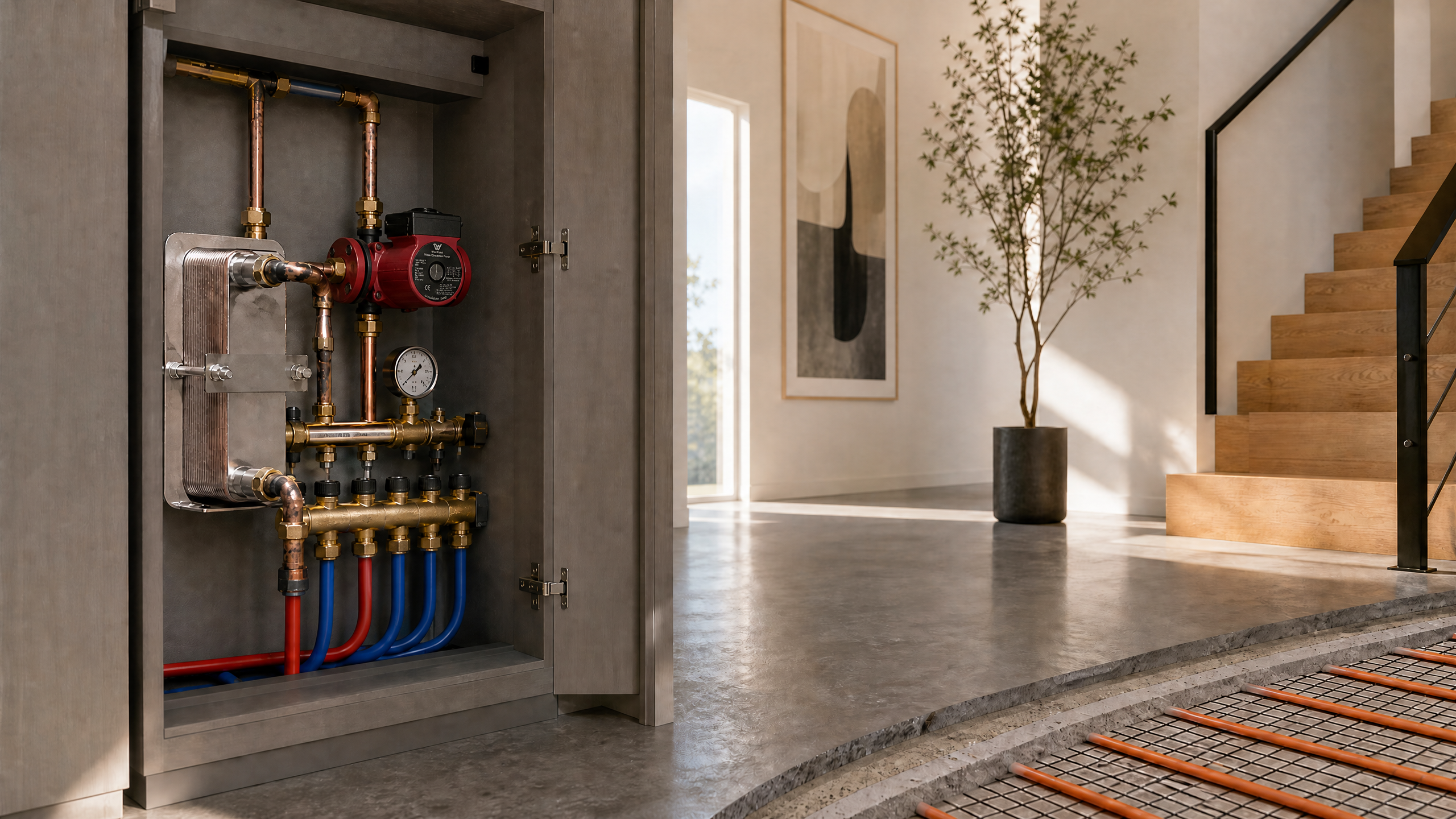
Radiant floor heating circulates warm water through tubing installed beneath or within a floor structure.
Because radiant floor systems typically operate at lower water temperatures than some boiler systems, a separate circuit can be useful when the heat source operates at a higher temperature.
A manifold distributes water to individual floor-heating circuits. In larger systems, a hydronic manifold can help organize multiple zones and provide a central point for controlling water distribution.
A heat exchanger may be used when the floor-heating circuit needs to remain hydraulically separated from the primary heat source.
Radiator Heating
Radiators transfer heat from circulating hot water into the surrounding air.
Traditional and modern systems can use different radiator designs and operating temperatures. Depending on the system configuration, the radiator loop may be connected directly to the boiler or separated through a heat exchanger.
For residential applications, modern hot water radiators can be combined with zone controls and circulating pumps to provide heating to individual rooms or areas.
Fan Coil Units
Fan coil units use a water coil and fan to transfer heat from the circulating water into the air.
The heated water flows through the coil while the fan moves air across the coil surface. The warmed air is then distributed into the occupied space.
This approach is common in hydronic HVAC systems where a central boiler or other heat source supplies hot water to multiple fan coil units. For a closer look at how this type of system is configured, see our Fan Coil Unit (FCU) Heating System application guide.
Forced-Air Heating
Hydronic heating can also be combined with forced-air systems.
Instead of circulating heated water directly through a radiator or floor loop, a water coil transfers heat into an airflow. Depending on the design, a liquid to air heat exchanger can be used to transfer heat from the water circuit to air.
This type of arrangement can be used in air handlers, ducted heating systems, workshops, garages, and other applications where warm air is preferred.
Multi-Zone Heating Systems
Larger hydronic systems may contain several heating zones, each with different temperature or flow requirements.
For example, one building could include:
- Radiators for bedrooms
- Radiant floor heating for bathrooms
- Fan coil units for common areas
- A separate domestic hot water circuit
Using separate circuits can make it easier to manage these different applications. Heat exchangers, pumps, valves, and manifolds can all play different roles depending on the system architecture.
How Heat Exchangers Improve Hydronic Heating Performance
A heat exchanger does not automatically make every heating system more efficient. Its main value is providing controlled heat transfer between separate fluid circuits.
When correctly selected and integrated into the system, this separation can provide several practical benefits.
1. Independent Temperature Control
Different heating applications often require different water temperatures.
For example, a radiant floor system may require a lower supply temperature than a traditional radiator system. Separating the circuits allows each side to be controlled according to its requirements.
2. Separation of Fluid Circuits
A heat exchanger can keep different fluids separated while still allowing heat to pass between them.
This can be useful when one circuit contains glycol, treated water, or another fluid that should not be mixed with the fluid in the secondary loop.
3. Greater System Flexibility
A separate heat-transfer circuit can make it easier to connect different heat sources and heating loads.
For example, a hydronic system may integrate a boiler with radiant floor heating, fan coils, or another secondary heating loop.
4. Support for Multi-Zone Systems
Separate hydraulic circuits can help accommodate zones with different flow and temperature requirements.
The circulation equipment and distribution components can then be selected according to each circuit rather than forcing the entire system to operate under identical conditions.
5. Easier System Isolation
When the primary and secondary circuits are separated, maintenance on one side may be performed without necessarily draining the entire heating system.
The actual maintenance requirements depend on the system design and installed valves, controls, and isolation components.
Choosing the Right Heat Exchanger for a Hydronic Heating System
The heat exchanger should be selected based on the operating conditions of the complete system rather than heating capacity alone.
Several factors should be considered.
Heating Capacity
The heat exchanger must be capable of transferring the required amount of heat under the actual operating conditions.
Capacity is typically expressed in BTU/hr or kW.
A nominal capacity rating by itself is not enough to determine whether a particular heat exchanger will perform as required. The inlet and outlet temperatures and flow rates on both sides affect the actual heat-transfer performance.
Water Temperature
The supply and return temperatures on both circuits are important.
For example:
- Primary side: 180°F supply / 160°F return
- Secondary side: 140°F supply / 120°F return
These conditions create a specific temperature difference that affects heat transfer.
Actual system temperatures should be used when selecting the heat exchanger rather than relying only on a general capacity number.
Flow Rate
Flow rate affects both heat-transfer performance and pressure drop.
The required flow depends on the heating capacity and temperature difference of each circuit. The available pump capacity should also be considered when evaluating the heat exchanger.
Pressure Drop
A heat exchanger introduces some pressure loss into the system.
The pressure drop should be compatible with the circulation pump and the rest of the piping system. A heat exchanger with an unsuitable pressure drop can affect the actual flow available to the heating circuit.
Fluid Compatibility
The materials of the heat exchanger should be compatible with the fluids on both sides.
This is particularly important when the system uses:
- Glycol solutions
- Treated water
- High-mineral-content water
- Other water-based fluids
Fluid chemistry and operating temperature should be reviewed when determining suitable materials and construction.
Heat Exchanger Type
Different heat exchanger designs can be suitable for different hydronic applications.
Brazed plate heat exchangers are often considered where a compact water-to-water heat exchanger is needed.
Shell-and-tube designs may be more appropriate for certain applications where different flow characteristics, maintenance requirements, materials, or connection configurations are needed.
The best choice depends on the complete system design rather than the heat exchanger type alone.
When Does a Hydronic Heating System Need a Heat Exchanger?
Not every hydronic heating system requires a separate heat exchanger.
A heat exchanger becomes particularly useful when two circuits need to exchange heat but should remain hydraulically or chemically separated.
Typical situations include:
Connecting a Boiler to a Secondary Heating Loop
A boiler may supply heat to a secondary circuit containing radiators, floor heating, or fan coil units.
Separating Different Water Conditions
If the primary and secondary loops require different water treatment or fluid compositions, a heat exchanger can provide thermal transfer while keeping the fluids separated.
Connecting Heating Zones with Different Requirements
Different zones may require different operating temperatures or flow conditions. Separate circuits can provide greater flexibility in system design.
Integrating Different Heat Sources
A heat exchanger can also be used when integrating certain boilers, heat pumps, solar thermal systems, or other heat sources with an existing hydronic heating circuit.
The exact system configuration should be evaluated based on the heat source, heating load, water temperatures, flow rates, pressure requirements, and fluid characteristics.
Designing a Reliable Hydronic Heating System
A hydronic heating system is more than a heat source and a heat exchanger. The overall performance depends on how the heat source, pumps, piping, valves, controls, distribution equipment, and heat emitters work together.
A typical system should be evaluated as a complete circuit:
Heat Source → Primary Loop → Heat Exchanger → Secondary Loop → Heating Equipment → Return
For systems with multiple zones, components such as hydronic manifolds, circulation pumps, mixing valves, and zone controls may be added to manage individual heating circuits.
The heat exchanger should therefore be selected after the main system requirements are understood.
For more information about different water-based heating applications, explore our Hydronic Heating Systems solutions, including radiant floor heating, radiator heating, fan coil systems, and other hydronic applications.
Overall, hydronic heating systems provide a flexible way to distribute heat using circulating water or water-based fluids. A heat exchanger is particularly useful when two heating circuits need to exchange thermal energy while remaining physically separated, allowing the system to accommodate different temperatures, fluid conditions, pressures, and operating requirements.
Selecting the right heat exchanger requires consideration of heating capacity, water temperature, flow rate, pressure drop, fluid compatibility, and the configuration of the overall heating system. Rather than selecting a heat exchanger based on capacity alone, evaluating the complete hydronic system helps ensure that the heat exchanger is properly matched to the intended application.
FAQ
Not every hydronic heating system requires a separate heat exchanger. A heat exchanger is typically used when two heating circuits need to transfer heat while remaining physically separated. For example, a boiler loop may be separated from a radiant floor, radiator, or other secondary heating circuit. This can be useful when the two circuits have different temperature, pressure, or fluid requirements.
A heat exchanger for a hydronic heating system should be sized based on the required heating capacity, inlet and outlet water temperatures, flow rates on both sides, and allowable pressure drop. Capacity should not be selected from the BTU/hr rating alone because actual heat-transfer performance depends on the operating conditions. For water-to-water applications, both the primary and secondary side conditions should be considered when selecting the heat exchanger.
There is no single water temperature that applies to every hydronic heating system. The required temperature depends on the heat source, heat emitters, building load, and system design. Radiators may operate at different temperatures from radiant floor heating, while fan coil and forced-air applications can have their own requirements. When a heat exchanger is used between two circuits, the supply and return temperatures on both sides should be considered because the temperature difference affects heat-transfer performance.
Yes. One of the main applications of a heat exchanger in hydronic heating is to transfer thermal energy between two separate fluid circuits without mixing the fluids. For example, the primary side may contain boiler water while the secondary side supplies a radiant floor or radiator circuit. The heat exchanger transfers heat through its heat-transfer surface while keeping the two fluids separated. This configuration can also be considered when the two circuits have different pressure, temperature, or fluid requirements.
The appropriate heat exchanger type depends on the system configuration, heating capacity, fluid conditions, temperature, flow rate, pressure drop, and installation requirements. Brazed plate heat exchangers are commonly considered for compact water-to-water heating applications, while shell-and-tube designs may be suitable for systems with different maintenance, material, flow, or connection requirements. Rather than choosing a heat exchanger based only on nominal capacity, the complete operating conditions of the hydronic heating system should be reviewed before selecting a model.


![Lead-Free, Brass Barbed Couplings 1/2" [10pk, 25pk, 50pk] - Alfa Heating Supply](http://alfaheating.com/cdn/shop/products/01.jpg?v=1588213888&width=600)