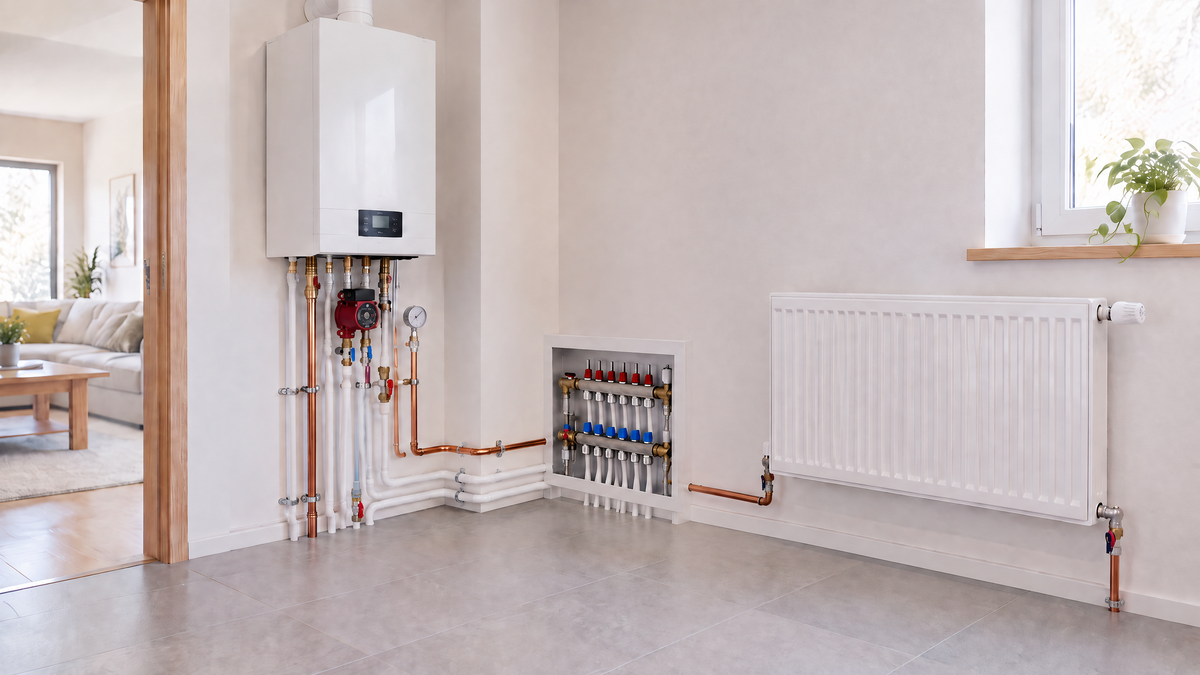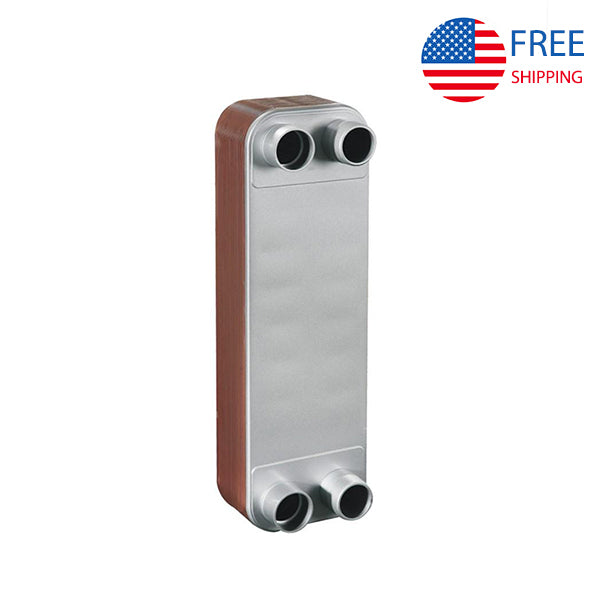
Choosing the right water to air heat exchanger is about more than matching the physical size of a coil to your furnace or ductwork. The required heating capacity, water temperature, water flow rate, airflow, coil dimensions, and pressure drop all affect how a heat exchanger performs in a hydronic heating or forced-air system.
A properly sized heat exchanger can transfer heat efficiently while working within the available pump and blower capacity. Whether you need a small water to air heat exchanger for a compact air handler or a larger coil for an outdoor wood furnace, the correct selection should be based on actual system operating conditions.
This guide explains the main factors to consider when sizing a water to air heat exchanger for outdoor wood furnaces, hydronic heating systems, forced-air furnaces, HVAC air handlers, and similar applications.
What Determines the Size of a Water to Air Heat Exchanger?
The required heat exchanger size is primarily determined by the operating conditions of the system rather than coil dimensions alone.
The most important factors are:
- Required heating capacity in BTU/hr
- Water inlet and outlet temperature
- Water flow rate in GPM
- Airflow in CFM
- Entering air temperature
- Available installation space
- Water-side and air-side pressure drop
A heat exchanger water to air application transfers heat from a circulating water or hydronic loop into an air stream. Because the two sides operate under different conditions, both water-side and air-side requirements need to be considered.
These conditions work together. A coil that produces a certain BTU/hr output at one water temperature and airflow may produce a different output under another set of operating conditions.
For this reason, heat exchanger performance should always be evaluated using operating conditions that are close to the actual system requirements.
1. Determine the Required Heating Capacity
The first step is to determine how much heat the system needs.
Heating capacity is typically expressed in BTU/hr. The required capacity should be based on the heating load of the space or equipment rather than simply choosing a coil based on its physical dimensions.
For example, a system requiring approximately 100,000 BTU/hr should be matched with a heat exchanger capable of delivering the required output under the expected water and air conditions.
However, a product labeled as a "100,000 BTU heat exchanger" should not automatically be assumed to provide 100,000 BTU/hr in every installation. Heat exchanger output depends on the operating conditions used to establish the rating.
When comparing models, check:
- Rated BTU/hr
- Water inlet temperature
- Water outlet temperature
- Water flow rate
- Airflow
- Entering air temperature
Performance data is especially important when comparing a liquid to air heat exchanger because the actual heat transfer capacity depends on the properties and operating conditions of the liquid side.
Why BTU/hr Is the Starting Point
If the coil is too small for the required heating load, increasing the water temperature or airflow may not fully compensate for insufficient heat transfer surface.
If the coil is substantially oversized, it may still operate effectively, but the additional cost, physical size, and installation requirements may not be justified.
The goal is to find a model that provides the required heating output under the actual operating conditions.
2. Check the Water Temperature
Water temperature is one of the most important factors affecting water to air heat exchanger performance.
A coil supplied with hotter water generally has a greater temperature difference between the water and the air, allowing more heat to be transferred. Lower-temperature hydronic systems may require a larger heat exchanger or different operating conditions to achieve the same heating output.
For example, a water to air heat exchanger connected to an outdoor wood boiler may operate at a different water temperature than a modern low-temperature hydronic heating system.
When sizing a coil, identify:
- Water inlet temperature
- Desired water outlet temperature
- Expected operating temperature range
Do not select a heat exchanger based only on a nominal BTU rating without checking the water temperature used for that rating.
3. Determine the Required Water Flow Rate
Water flow rate is normally expressed in GPM (gallons per minute).
For water systems, a commonly used relationship for estimating required flow is:
GPM = BTU/hr ÷ (500 × ΔT)
where ΔT is the temperature difference between the water entering and leaving the heat exchanger.
For example, if a system needs to transfer approximately 100,000 BTU/hr and the desired water temperature drop is 20°F:
GPM = 100,000 ÷ (500 × 20)
GPM = 10
So the approximate required water flow is 10 GPM.
This calculation provides a useful starting point for evaluating the hydronic side of the system. It does not, by itself, determine which coil will deliver 100,000 BTU/hr. Actual performance must still be checked against water temperature, airflow, coil design, and manufacturer performance data.
Why Water Flow Matters
Insufficient water flow can limit heat transfer and reduce available heating output.
Higher flow can increase heat transfer, but it can also increase water-side pressure drop and pump requirements. The goal is therefore not simply to maximize GPM, but to operate the selected heat exchanger within an appropriate flow range.
4. Determine the Required Airflow
For forced-air applications, airflow in CFM (cubic feet per minute) is another important sizing factor.
A commonly used HVAC relationship for estimating sensible heat transfer on the air side is:
BTU/hr ≈ 1.08 × CFM × ΔT
where:
- BTU/hr = heat transferred to the air
- CFM = airflow
- ΔT = air temperature rise in °F
For example, if a system needs to transfer 50,000 BTU/hr to the air and the desired air temperature rise is 40°F:
CFM ≈ 50,000 ÷ (1.08 × 40)
CFM ≈ 1,157
This gives an approximate airflow requirement.
The actual performance of a water to air heat exchanger depends on coil design and entering water and air conditions, so this calculation should be used as a preliminary estimate rather than a substitute for manufacturer performance data.
Why CFM Matters
The heat exchanger must be compatible with the blower or air handler serving the system.
For systems that require a water to air heat exchanger with blower, the blower must be capable of delivering the required CFM while overcoming the air-side pressure drop of the coil.
The same principle applies when selecting a heat exchanger with fan or heat exchanger with blower for a custom heating system. The fan or blower should be sized according to the required airflow and system static pressure.
Consider:
- Available blower capacity
- Required system airflow
- Air-side pressure drop
- Coil face area
- Duct dimensions
A coil that is too restrictive can increase static pressure and affect overall airflow.
5. Match the Coil Size to the Available Space
Once the required heating performance and operating conditions are known, check whether the selected coil physically fits the installation.
Important dimensions include:
- Coil width
- Coil height
- Coil depth
- Connection size
- Connection location
- Available clearance
- Duct or furnace opening
For example, a small water to air heat exchanger may be appropriate for a compact air handler or limited installation space, but its heating capacity still needs to match the system requirements.
A larger coil may provide greater heat transfer capacity, but the available space and airflow path must also be considered.
Coil Face Area and Airflow
Coil dimensions also affect airflow through the heat exchanger.
A larger face area can allow the required airflow to pass through the coil at a lower face velocity, which can help manage air-side pressure drop.
Therefore, do not evaluate coil dimensions independently from the required CFM.
6. Check Water-Side and Air-Side Pressure Drop
Pressure drop is another important consideration when selecting a water to air heat exchanger.
There are two separate pressure-drop considerations.
Water-Side Pressure Drop
Water-side pressure drop affects the circulator or pump required to move water through the coil.
The available pump head must be sufficient to overcome the pressure drop of the heat exchanger along with the rest of the hydronic circuit.
Air-Side Pressure Drop
Air-side pressure drop affects the blower and the total static pressure of the forced-air system.
Adding a heat exchanger coil to existing ductwork or a furnace can introduce additional resistance to airflow. The blower must be capable of maintaining the required CFM at the resulting system pressure.
Therefore, the best heat exchanger is not necessarily the one with the highest BTU rating. It should provide the required heating output while remaining compatible with the available pump and blower capacity.
Water to Air Heat Exchanger Sizing Example
Consider a simplified hydronic heating application with the following requirements:
- Required heat output: 100,000 BTU/hr
- Water temperature: 180°F entering
- Desired water temperature drop: 20°F
- Available airflow: approximately 1,200 CFM
- Installation: forced-air furnace or air handler
Step 1: Estimate Water Flow
Using the standard water-side relationship:
GPM = BTU/hr ÷ (500 × ΔT)
For 100,000 BTU/hr and a 20°F water temperature drop:
GPM = 100,000 ÷ (500 × 20)
GPM = 10 GPM
This gives an approximate hydronic flow requirement.
Step 2: Check Airflow
Using the air-side relationship:
BTU/hr ≈ 1.08 × CFM × ΔT
At 1,200 CFM:
Air temperature rise ≈ 100,000 ÷ (1.08 × 1,200)
Air temperature rise ≈ 77°F
This is a theoretical calculation showing that 1,200 CFM would require a substantial air temperature rise to transfer 100,000 BTU/hr under the simplified assumptions.
The actual heat exchanger selection should instead be based on manufacturer performance data for the specific entering water temperature, water flow, entering air temperature, and airflow.
Step 3: Compare Available Models
Once the approximate operating conditions are known, compare heat exchanger performance data for models that can:
- Deliver the required BTU/hr
- Operate at the available water temperature
- Handle the required water flow
- Operate at the available airflow
- Fit the available installation space
- Maintain acceptable water-side and air-side pressure drop
This is where manufacturer performance data becomes more useful than simply comparing physical coil dimensions.
Sizing a Water to Air Heat Exchanger for an Outdoor Wood Furnace
Outdoor wood furnaces and wood boilers are common applications for water to air heat exchangers.
In a typical system:
Outdoor wood furnace → hot water → water to air heat exchanger → blower → ductwork → heated space
The heat exchanger transfers energy from the hot water loop into the air stream without directly mixing the two circuits.
When selecting a coil for an outdoor wood furnace, pay particular attention to:
- Boiler water temperature
- Available water flow
- Required heating capacity
- Existing furnace or duct dimensions
- Blower airflow
- Water-side pressure drop
- Air-side pressure drop
A water heat exchanger with fan can be useful in applications where the heat exchanger and air-moving equipment need to operate as a combined heating unit. However, the fan capacity and coil performance should be evaluated together rather than separately.
Water to Air vs. Air to Water Heat Exchangers
The terms water to air heat exchanger and air to water heat exchanger describe different heat-transfer directions.
A water to air heat exchanger transfers heat:
Hot water → air
It is commonly used for hydronic heating, outdoor wood furnaces, forced-air furnaces, and HVAC air handlers.
An air to water heat exchanger transfers heat in the opposite direction:
Air → water
These two applications should not be treated as interchangeable when selecting equipment.
The phrase air water heat exchanger is sometimes used as a general or reversed description, but the actual direction of heat transfer and the operating conditions should always be confirmed before selecting a product.
Common Sizing Mistakes to Avoid
Choosing a Coil Based Only on Physical Size
A larger coil is not automatically the correct coil. Heating performance depends on operating conditions as well as physical dimensions.
Choosing Based Only on the BTU Label
A nominal BTU rating without the associated water temperature, airflow, and flow rate does not provide enough information for an accurate comparison.
Ignoring Water Flow
A coil may have sufficient heat transfer area but still fail to reach the expected output if the hydronic system cannot provide the required flow.
Ignoring Airflow and Pressure Drop
The heat exchanger becomes part of the air distribution system. Make sure the blower can maintain the required airflow after the coil is installed.
Measuring Only the Opening
Before ordering, verify the actual coil dimensions, depth, connection configuration, and installation clearance rather than measuring only the furnace or duct opening.
Water to Air Heat Exchanger Sizing Checklist
Before selecting a model, gather the following information:
- Required heating capacity: BTU/hr
- Water inlet temperature: °F
- Water outlet temperature: °F
- Water flow rate: GPM
- Airflow: CFM
- Entering air temperature: °F
- Available coil dimensions: Width × Height × Depth
- Water connection size: Inlet and outlet
- Maximum allowable water-side pressure drop
- Maximum allowable air-side pressure drop
Having these parameters available makes it much easier to compare models and identify a suitable heat exchanger.
Need Help Selecting the Right Water to Air Heat Exchanger?
Water to air heat exchanger sizing depends on the relationship between heating capacity, water temperature, water flow, airflow, and coil dimensions.
If you are unsure which model is appropriate for your application, provide your system requirements and operating conditions. Our team can help you identify a suitable model for your hydronic heating, outdoor wood furnace, forced-air furnace, or HVAC air handler application.
For sizing assistance, send us:
- Required BTU/hr
- Water inlet and outlet temperature
- Water flow rate or pump information
- Airflow / CFM
- Available installation space
- Application type
FAQ
The required size depends on the heating capacity, water temperature, water flow rate, airflow, and available installation space. The heat exchanger should be selected based on its performance under conditions similar to your system, rather than physical dimensions alone.
The actual BTU/hr output depends on water temperature, water flow rate, airflow, entering air temperature, and coil design. Always compare performance data using operating conditions that closely match your application.
Required water flow depends on the desired heat output and water temperature drop. A preliminary GPM requirement can be estimated from the heating load and water ΔT, but the heat exchanger's recommended flow range and water-side pressure drop should also be considered.
Required airflow depends on the desired heating output, air temperature rise, and coil performance. The available blower capacity and air-side pressure drop should also be checked to ensure the selected coil works properly with the existing HVAC or duct system.
Yes. Water to air heat exchangers are commonly used to transfer heat from outdoor wood furnaces or hydronic boilers into forced-air heating systems. The coil should be properly sized according to the boiler water temperature, water flow, required BTU output, airflow, and available installation space.