Choosing the right pool heat exchanger is an important step when designing or upgrading a swimming pool heating system. Two of the most commonly used types are the plate heat exchanger and the shell and tube heat exchanger.
Both can transfer heat efficiently between two separate water circuits, but they work differently and are used in different situations. Understanding their differences can help you select the most suitable option for your pool heating needs.
Understanding Pool Heat Exchangers in Real Applications
A pool heat exchanger is a device that transfers heat from a primary heat source (such as a boiler, heat pump, or solar heating system) to swimming pool water without mixing the two water circuits.
In daily use, it is a key part of a swimming pool heating system, helping maintain comfortable water temperature for swimming, relaxation, or spa use.
Common real-life applications include:
- Residential backyard swimming pools
- Villa or private pools with seasonal heating needs
- Spa pools and hot tubs
- Small hotel or boutique pool systems
In these situations, the heat exchanger works continuously or intermittently depending on the desired pool temperature and usage schedule.
What is a Plate Heat Exchanger for Swimming Pools
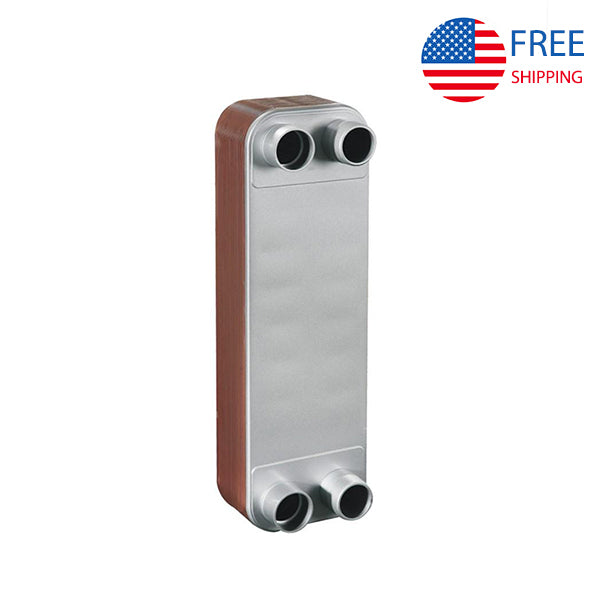
A plate heat exchanger is made of multiple thin metal plates stacked together. Hot and cold fluids flow through alternating channels, allowing heat to transfer efficiently through the plate surfaces.
How it works in a pool heating system
In a typical setup, hot water from a boiler or heat pump flows through one side, while pool water flows through the other. Heat is transferred through the plates without direct contact between the two water systems.
Common materials
- Stainless steel plate heat exchangers (freshwater applications)
- Titanium plate heat exchangers (commonly used in saltwater pools or corrosive environments)
Typical usage scenarios
Plate heat exchangers are often used in:
- Systems with limited installation space
- Residential swimming pools
- Applications requiring compact equipment design
In some installations, users may notice that compact equipment is preferred due to limited pump room space, which is where Brazed Plate Heat Exchangers are often selected.
What is a Shell and Tube Heat Exchanger?
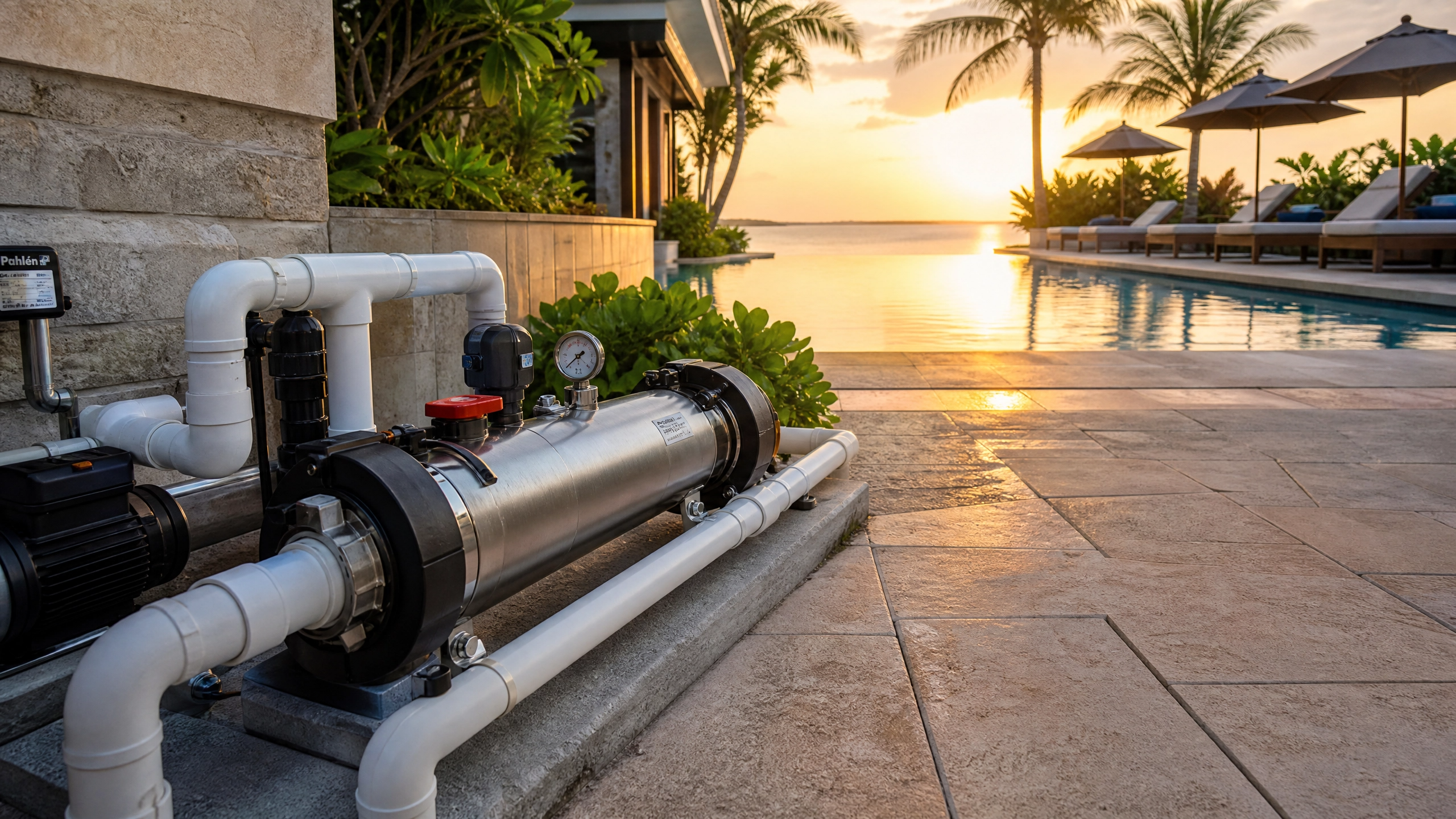
A shell and tube heat exchanger consists of a series of tubes enclosed inside a larger cylindrical shell. One fluid flows inside the tubes, while the other flows around the tubes inside the shell.
How it works in pool heating
Hot water passes through the tube bundle, while pool water flows around the tubes inside the shell, allowing heat transfer through the tube walls.
Why it is widely used
This type of heat exchanger has been used for many years in industrial and commercial systems due to its robust structure and stable operation.
Typical installation characteristics
- Requires more installation space
- Often used in mechanical rooms with larger equipment layouts
- Suitable for higher flow rate systems
In real-world pool installations, this type is often chosen when system stability and robustness are more important than compact size.
Plate vs Shell and Tube Heat Exchanger: Key Differences Explained
Although both types serve the same purpose, their performance and application conditions differ.
Heat transfer efficiency
Plate heat exchangers generally provide a higher heat transfer surface area due to their multi-layer plate design. This allows more efficient heat exchange in compact systems.
Shell and tube heat exchangers provide stable heat transfer performance, especially in continuous operation systems, but typically require a larger surface area to achieve similar efficiency.
Space and installation requirements
One of the most noticeable differences is size.
Plate heat exchangers are compact and suitable for installations where space is limited, such as residential pump rooms.
Shell and tube heat exchangers require significantly more space and are often installed in larger mechanical rooms or commercial facilities.
A common real-life issue is that many residential pool owners have limited equipment space, making compact design an important factor in selection.
Maintenance and cleaning considerations
Water quality has a direct impact on Pool Heat Exchangers performance over time.
Plate heat exchangers can be more sensitive to scaling or fouling if water quality is poor, but they are generally easier to open and clean when maintenance is required.
Shell and tube heat exchangers are more tolerant of slightly dirty water conditions and may operate for longer periods with less frequent cleaning, although maintenance can be more time-consuming when required.
In practice, users often choose based on how easy it is to access and maintain the system rather than only technical specifications.
Cost and long-term operation
Initial cost and long-term maintenance should both be considered.
Plate heat exchangers usually have a lower to moderate initial cost depending on material and size.
Shell and tube heat exchangers may require higher installation space and cost but can offer stable operation in more demanding environments.
How to Choose Between Plate and Shell and Tube Heat Exchangers?
The right choice depends on real operating conditions rather than a single performance factor.
Based on pool type and usage
- Residential swimming pools → Plate heat exchanger is commonly used
- Commercial or shared pools → Shell and tube heat exchanger may be preferred
Based on water quality
- Clean, well-maintained water systems → Plate heat exchanger works efficiently
- Water with higher particle content → Shell and tube heat exchanger may perform more reliably
Based on installation space
- Limited pump room space → Plate heat exchanger
- Larger mechanical room → Shell and tube heat exchanger
Based on maintenance preference
Some users prefer systems that are easier to access and clean, while others prioritize longer maintenance intervals. This is often a practical deciding factor in real installations.
Both plate heat exchangers and shell and tube heat exchangers are widely used in swimming pool heating systems. The main differences are related to size, installation conditions, maintenance approach, and application scenarios.
In many real-world cases, the choice is not about which one is better overall, but which one is more suitable for the specific pool system design.
Related Reading
-
Titanium vs Stainless Steel Pool Heat Exchanger: Which Is Better for Saltwater Pools?
- How to Size a Pool Heat Exchanger for Your Swimming Pool
FAQ
Plate heat exchangers are commonly used in residential swimming pool heating systems because of their compact size and efficient heat transfer performance. They are especially suitable for installations where equipment room space is limited.
In many home pool systems, users prefer plate heat exchangers because they can quickly transfer heat while occupying less space than larger traditional units.
However, whether a plate heat exchanger is the better choice depends on several factors, including water quality, heating source, maintenance conditions, and overall system design. For example, pools with stable water quality and regular maintenance schedules are often well suited for plate heat exchanger applications.
Yes, shell and tube heat exchangers can also be used for residential swimming pools, although they are more commonly installed in commercial or larger-scale systems.
Some homeowners choose shell and tube heat exchangers when they prioritize structural durability or when their pool system handles higher flow rates. They may also be selected in environments where pool water quality is less stable or where debris and particles are more likely to circulate in the system.
Because shell and tube heat exchangers usually require more installation space, they are generally more suitable for equipment rooms with sufficient layout flexibility.
In many cases, plate heat exchangers are considered easier to clean and maintain because their internal structure is more accessible. Some models can be disassembled for inspection and cleaning when scaling or fouling occurs.
Shell and tube heat exchangers may require less frequent cleaning in systems with slightly contaminated water, but maintenance procedures can take longer due to the larger structure and tube bundle design.
The actual maintenance frequency depends heavily on water quality, pool chemical balance, filtration system performance, and operating temperature.
For swimming pools with hard water or inconsistent water treatment, regular inspection is important regardless of heat exchanger type.
Yes. Water quality is one of the most important factors affecting the long-term performance of a pool heat exchanger.
Poor water conditions can lead to scaling buildup, mineral deposits, fouling inside heat transfer surfaces, and reduced heat transfer efficiency over time.
For example, high calcium levels or improper chemical balance may gradually reduce heat exchange performance.
Saltwater pools also require careful material selection. In these systems, titanium heat exchangers are commonly used because they are more suitable for corrosive environments compared to standard stainless steel materials.
Maintaining proper filtration and balanced pool chemistry can help extend the service life of both plate and shell and tube heat exchangers.
The lifespan of a pool heat exchanger depends on operating conditions, maintenance frequency, material selection, and water quality.
In properly maintained swimming pool systems, heat exchangers can operate reliably for many years. However, factors such as poor water chemistry, corrosion, scaling, or insufficient maintenance may shorten service life.
Some of the most important factors include freshwater vs saltwater application, stainless steel vs titanium material, water cleanliness, system operating temperature, and frequency of cleaning and inspection.
Regular maintenance and proper system sizing can help improve long-term reliability and overall heating performance.




![Brass Barbed Tees 1/2"x1/2"x1/2" Lead Free PEX Crimp"T" Fitting [5pk, 10pk, 25pk]](http://alfaheating.com/cdn/shop/products/brass-barded-tee.jpg?v=1603079042&width=600)