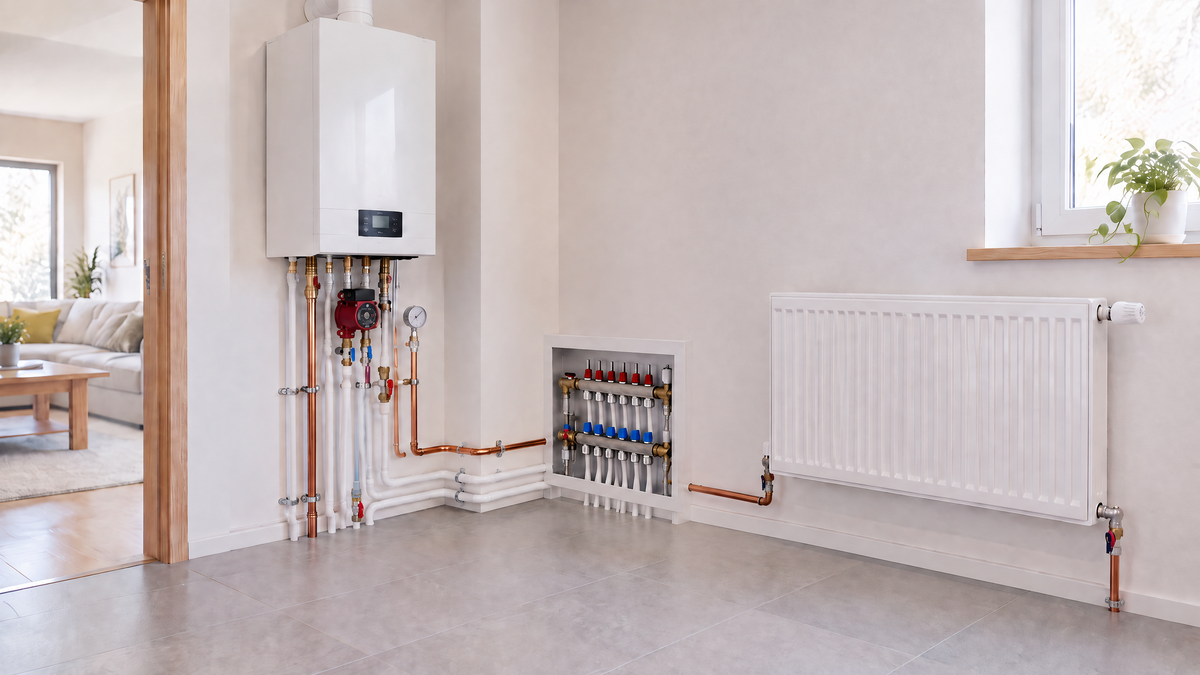
From heat transfer to real-world use, this article explains how these systems operate, where they fit best, and what sets them apart in industrial settings.
How hydraulic heating systems work
Hydraulic heating systems move heat through a sealed circuit filled with water or a water-glycol mixture. A heat source raises the fluid temperature, a pump sends it through piping, and terminal units release thermal energy where it is needed. The fluid then returns to the source and repeats the cycle. That closed loop keeps delivery steady and controlled.
The core principle is simple: the fluid carries heat, while valves and controls manage how much of that heat reaches each zone. In practical terms, heat transfer in hydraulic systems happens at emitters or heat exchangers that pass energy to air, surfaces, or process media. Because water transports heat efficiently, the system can serve rooms, machines, or production lines with less temperature swing and greater stability than many air-based layouts.
Common heat sources include boilers, heat pumps, and central plant equipment. In many systems, a heat pump moves heat from air, ground, water, or waste-heat sources rather than creating most of it directly, which supports lower electrical input for the same output. The loop may use plain water or a glycol blend when freeze protection is required. Properly formulated mixtures also support corrosion protection.
Compared with forced-air layouts, hydraulic heating systems use piping as the main distribution path instead of large ducts. This reduces exposure to drafts, duct leakage, and fan-driven air movement. The result is quieter operation and more even heat delivery across multiple spaces. Forced-air systems still remain useful where ventilation and air exchange are part of the design.
Efficiency also comes from the closed-loop structure. Once the fluid leaves part of its heat at the terminal unit, it returns to the source and is reheated without being lost to the building exterior. This repeatable cycle supports stable operation and smoother response to changing load conditions. It also helps reduce energy waste in facilities with variable occupancy or process demand.
Where industrial hydraulic heating is used
Industrial hydraulic heating is used in places that need steady temperatures across large areas or sensitive processes. Manufacturing plants rely on it for assembly zones, curing lines, machine halls, and preheating tasks. Warehouses use it to limit condensation and protect stored goods from frost or thermal swings. Agricultural buildings use it in greenhouses, barns, hatcheries, and crop drying areas.
The same approach also fits processing facilities where temperature affects product quality, viscosity, drying time, or sanitation results. Food and beverage plants use it in preparation rooms, washing areas, and bottling lines. Textile, wood, printing, and chemical operations use heating systems for industrial applications when repeatable thermal conditions support consistent output. Campus-scale and district-scale installations extend the same principle across several connected buildings or service blocks.
Typical sectors and use cases include manufacturing plants, warehouses, agricultural buildings, processing facilities, schools, hospitals, municipal buildings, and utility sites. In each case, the value comes from stable heat delivery over long distances and across different zones. That flexibility makes the system useful where a single source serves multiple rooms, halls, or structures. It also supports both space heating and process heating in the same network.
Why hydronic heating solutions support efficient temperature control
Hydronic heating solutions support efficient temperature control because they deliver heat in a measured way and allow each zone to operate at the needed level. Separate loops, sensors, and control valves adjust output based on occupancy or load. This keeps temperatures more even in open rooms, perimeter areas, and process spaces. It also lowers unnecessary energy use.
The same structure helps reduce losses linked to airflow and stratification in tall or expansive interiors. Liquid-based distribution is often more precise than pushing warm air through long ducts, especially where the layout is wide or the demand changes during the day. The system also fits low-mass or high-mass emitters, so response can be quick or steady depending on the application. That balance matters in facilities with variable use.
A compact comparison of practical effects is shown below:
|
feature |
practical effect |
|---|---|
|
zoned control |
temperature levels match actual demand in different areas |
|
liquid-based heat delivery |
heat spreads evenly across larger rooms or process zones |
|
closed-loop circulation |
stable operation with less energy waste and smoother response |
|
compatibility with emitters and heat exchangers |
works for space heating, process heating, and central plant use |
Design quality determines how well the system performs over time. Accurate load calculations, correct pipe and pump sizing, balancing, insulation, and commissioning all affect comfort and reliability. Maintenance access, pressure testing, flushing, and regular checks also matter. In critical facilities, redundancy can support continuity when one component is offline.
Water quality and fluid choice are equally important. Plain water is common, but glycol is used where freeze protection is needed, and a properly formulated blend can also help with corrosion control. Radiant floor systems often use lower water temperatures than many traditional emitters, which matches well with modern heat pumps and improves overall system efficiency. These factors shape both performance and service life.